Results: does language grounding help?
Short answer: yes, mostly, and about a seventh of it is leakage. Adding free-text function annotations to a frozen ESM-2 representation improves macro-F1 from 0.616 to 0.740 on held-out proteins, and pairing each protein with a different protein's text destroys the gain, which rules out the boring explanation.
Ablating the sentences that name a compartment costs 15% of that gain, so the prose is partly reading the answer. A further 53% turns out to depend simply on having the full annotation, which only a length-matched random control could reveal. See Separating grounding from leakage.
The separate structured-annotation arm shows what blatant label leakage looks like, and it scores far higher still. See Interpretation.
Produced by the runs of 2026-07-30 21:55 UTC (six arms) and 2026-07-31 14:37 UTC
(the ablation arms); provenance in
projects/grounding-multimodal/results/run_manifest_all.json and
ablation_all.json. The original six arms reproduced bit-for-bit in the later
run, which is what licenses reading the two together.
Headline
2,773 held-out proteins from DeepLoc's homology-partitioned test split. Mean over 3 seeds, standard deviation across seeds. Majority-class accuracy floor: 0.291. Macro-F1 is the metric to read, since the classes are 26-fold imbalanced and it weights every compartment equally regardless of size; it is defined, with the other metrics here, in Method.
| Arm | Accuracy | Macro-F1 | Balanced acc. |
|---|---|---|---|
| sequence-only | 0.755 ± 0.004 | 0.616 ± 0.004 | 0.599 ± 0.004 |
| text-only, free text | 0.690 ± 0.005 | 0.617 ± 0.015 | 0.585 ± 0.010 |
| text-only, structured | 0.936 ± 0.001 | 0.912 ± 0.001 | 0.899 ± 0.003 |
| sequence + free text | 0.835 ± 0.007 | 0.740 ± 0.006 | 0.716 ± 0.009 |
| sequence + structured | 0.939 ± 0.001 | 0.906 ± 0.005 | 0.893 ± 0.005 |
| shuffled-text control | 0.737 ± 0.002 | 0.578 ± 0.006 | 0.564 ± 0.004 |
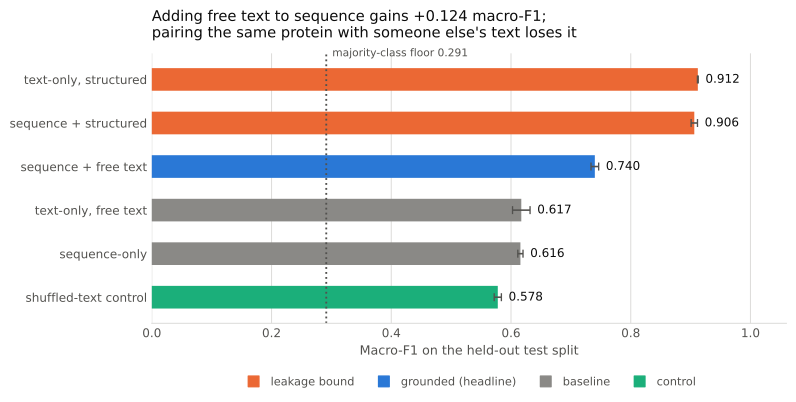
Macro-F1 per arm, error bars showing the standard deviation across 3 seeds. Orange marks the structured arms, which bound what label leakage looks like on this task; the control in green sits below the sequence-only baseline.
Three things to take from this table.
The grounded arm beats sequence-only by 0.124 macro-F1. Seed spread is about 0.005, so the gap is more than twenty times the noise. This is not a seed artifact.
The shuffled control lands below sequence-only, at 0.578 against 0.616. This is the result that makes the headline mean something. The control keeps each protein's own sequence but hands it another protein's annotation, so it has exactly the same 864 input dimensions and exactly the same head capacity as the grounded arm. If the gain came merely from feeding the model more numbers, the control would capture it. Instead the extra 384 dimensions of mismatched text are mild noise and cost a little accuracy. The improvement is therefore tied to this protein's annotation, which is the definition of grounding for this experiment.
Free text alone matches sequence alone on macro-F1 (0.617 versus 0.616) while scoring lower on accuracy (0.690 versus 0.755). The two modalities are roughly comparable in information content but distribute it differently across classes, which is consistent with them being complementary rather than redundant.
Where the gain comes from
Per-class F1 on the all-proteins cohort, ordered by sequence-only performance:
| Compartment | Share | sequence-only | sequence+free text | Δ |
|---|---|---|---|---|
| Extracellular | 14.2% | 0.907 | 0.923 | +0.016 |
| Plastid | 5.5% | 0.844 | 0.860 | +0.016 |
| Nucleus | 29.2% | 0.834 | 0.900 | +0.066 |
| Mitochondrion | 10.9% | 0.806 | 0.879 | +0.072 |
| Cell membrane | 9.7% | 0.777 | 0.809 | +0.032 |
| Cytoplasm | 18.3% | 0.644 | 0.745 | +0.101 |
| Endoplasmic reticulum | 6.2% | 0.552 | 0.685 | +0.134 |
| Lysosome/Vacuole | 2.3% | 0.317 | 0.586 | +0.269 |
| Golgi apparatus | 2.6% | 0.298 | 0.442 | +0.144 |
| Peroxisome | 1.1% | 0.167 | 0.519 | +0.352 |
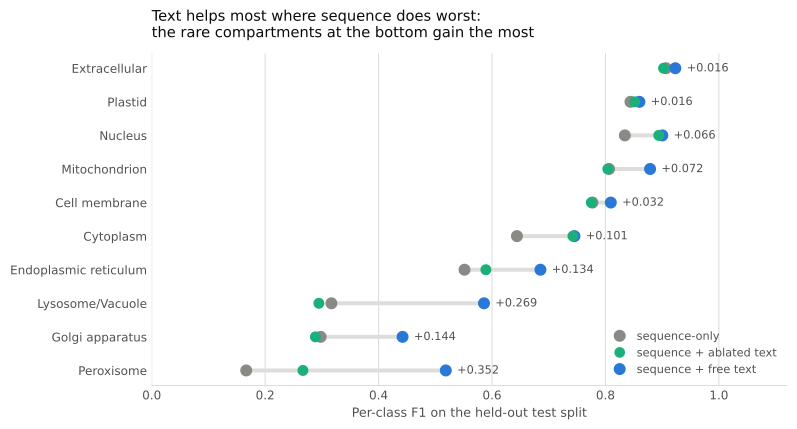
Each row is one compartment: grey is sequence-only, blue is sequence + free text, and the bar between them is the gain. Rows are ordered by sequence-only performance, so the widening gaps toward the bottom are the whole finding.
The gain is concentrated in the classes the sequence model handles worst, and those are largely the rare ones. Peroxisome roughly triples and Lysosome/Vacuole nearly doubles. Extracellular, where sequence already scores 0.907 because secretion signals are blatant in the N-terminus, gains almost nothing.
Per-class F1 on a class with only about 30 test proteins is a noisy statistic, so
read the rare-class rows as a pattern rather than as precise values; Peroxisome in
particular moved by more than 0.07 between two runs that differ only in the
embedding code path (see the 2026-07-30 speedup entry in DECISION_LOG.md).
This is a coherent story rather than a curiosity. Rare compartments give a sequence model few examples to learn their targeting motifs from, while a curator writing a functional description will still say what the protein does and where it acts. Text is most useful exactly where sequence evidence is thinnest.
The shuffled control reinforces it from the other side: its worst damage is also in the rare classes, dropping Lysosome/Vacuole from 0.317 to 0.130. Rare classes have the least signal to spare, so they are the most sensitive both to real information and to noise.
The annotation-coverage question
8.9% of proteins have no free-text function annotation and receive a zero vector, which raised the question of whether the headline should be reported on all proteins or only on annotated ones. Both were run:
| Cohort | n test | sequence-only | sequence+free text | Δ |
|---|---|---|---|---|
| All proteins | 2,773 | 0.616 | 0.740 | +0.124 |
| Annotated only | 2,534 | 0.619 | 0.750 | +0.130 |
The choice does not matter. The gain is 0.124 on one cohort and 0.130 on the other, close enough given a seed spread of 0.003 to 0.007 that the conclusion is the same either way. Reporting the all-proteins number is therefore honest and loses nothing.
Both rows come from impl_version 2 vectors: the annotated-only cohort was
re-run alongside the all-proteins one after the embedding speedup
(results/run_manifest_annotated.json), so the table is two runs of identical
code rather than a comparison across implementations.
One difference is worth noting: text-only rises from 0.617 to 0.664 when un-annotated proteins are excluded, which is expected, since on the full cohort that arm is asked to classify 239 test proteins from a zero vector. That it affects the text-only arm but not the combined arm suggests the head learns to lean on sequence when text is uninformative.
Interpretation
The narrow claim is supported: adding curated function text to a frozen protein-sequence representation measurably improves subcellular localization, and the improvement is specific to the protein's own text rather than an artifact of extra input dimensions.
The broader claim, that this constitutes grounding in biological knowledge, is not established by these six arms alone, and the structured arm is why.
GO terms and keywords score 0.912 on their own, close to a ceiling. Those fields
frequently contain the label verbatim: Q9H400 is labelled Cell membrane and its
keywords literally include "Cell membrane". So that arm mostly measures the
model's ability to read an answer key, and it usefully bounds what pure leakage
looks like on this task: about 0.91.
Free text sits at 0.740, between sequence-only at 0.616 and the leakage ceiling at 0.912. That position is consistent with two different stories that these six arms cannot separate:
- Function prose carries genuine functional information that complements sequence, or
- Function prose sometimes states the localization outright, and the arm is partially reading the answer, just less reliably than the structured fields.
Story 2 is entirely plausible. Curated descriptions routinely mention compartment in passing: the example quoted in data.md contains "across cell membrane" for a protein labelled Cell membrane. The per-class pattern does not settle it either, since a curator is arguably more likely to state the location explicitly for an unusual compartment like peroxisome, which would predict the same rare-class concentration observed above.
Separating the two stories takes an ablation that removes localization-stating sentences from the free text and re-runs. That has now been done, and the answer is neither story cleanly. See Separating grounding from leakage.
Two smaller observations:
- Adding sequence to the structured arm does not help. 0.906 with sequence against 0.912 without, a difference within about one standard deviation. Once the text contains the answer, the sequence contributes nothing.
- Every arm clears the 0.291 majority floor comfortably, so no arm is degenerate.
Separating grounding from leakage
The interpretation above left one question open: how much of the +0.124 is the text carrying function, and how much is it naming the compartment? To answer it, sentences mentioning any of the ten compartments or their synonyms are removed from the free text and the arms re-run. The filter, its vocabulary, and the judgement calls behind it are documented in Ablation filter; it trims 13.5% of sentences and leaves 83.6% of the corpus characters.
Two extra conditions make the comparison interpretable. A cleaned arm strips
the {ECO:...} codes and FUNCTION: prefix but ablates nothing, which separates
"removed the answer" from "removed the bookkeeping". A random-ablated control
removes the same number of sentences per protein, chosen at random, which
separates "removed the answer" from "removed text".
| Arm | Macro-F1 | vs sequence-only |
|---|---|---|
| sequence-only | 0.616 ± 0.004 | |
| sequence + free text | 0.740 ± 0.006 | +0.124 |
| sequence + cleaned text | 0.743 ± 0.004 | +0.127 |
| sequence + random-ablated text | 0.674 ± 0.013 | +0.058 |
| sequence + ablated text | 0.655 ± 0.013 | +0.039 |
| text-only, free text | 0.617 ± 0.015 | |
| text-only, cleaned | 0.629 ± 0.005 | |
| text-only, random-ablated | 0.519 ± 0.011 | |
| text-only, ablated | 0.483 ± 0.007 |
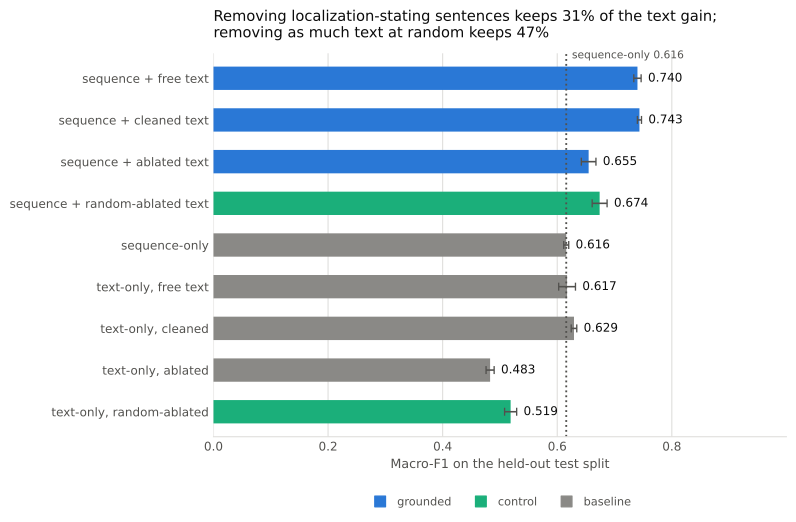
The ablation ladder. The bar to compare the ablated arm against is the random-ablated control directly above it, not the unfiltered arm at the top.
Cleaning the evidence codes changes nothing. 0.743 against 0.740, within one
standard deviation. This resolves the open preprocessing question flagged in
data.md: the {ECO:...} markers and the constant FUNCTION: prefix
were 22% of the corpus by character count, and removing them moves no arm
materially. Worth knowing, and it means the unfiltered baseline was never
contaminated by bookkeeping.
The ablation drops the arm to 0.655, but most of that is not leakage. Read against the unfiltered arm alone, 69% of the gain vanishes, which looks like a damning leakage result. Read against the length-matched control, it is not: removing an equal number of randomly chosen sentences drops the arm to 0.674, almost as far. The gain is fragile to losing text at all, because the filter takes text disproportionately from the rare compartments where the gain was concentrated (72% of Mitochondrion proteins lose a sentence, against 14% of Extracellular ones).
That splits the +0.124 three ways:
| Component | Macro-F1 | Share of the gain |
|---|---|---|
| Lost by removing 13.5% of sentences at all | 0.066 | 53% |
| Lost specifically because those sentences named the compartment | 0.019 | 15% |
| Survives both | 0.039 | 31% |
All three shares are of the unfiltered gain. Anchoring instead on the cleaned arm, which is what the ablated variants actually derive from, shifts the split by about a point and changes nothing; the unfiltered arm is used because it is the number the MVP reported.
The leakage component is small but real. 0.019 macro-F1 is smaller than either arm's seed spread, so the standard deviations in the table above do not settle it. The per-seed pairing does: the ablated arm sits below the control in all three seeds, by 0.018, 0.013 and 0.026. Seeds share a split and an initialization stream, so the paired difference is far better resolved than the individual spreads suggest. The sign is consistent; the magnitude is worth about one seventh of the effect.
So, against the three outcomes the experiment was set up to distinguish:
- Not "the gain largely survives": only a third of it does.
- Not "the gain collapses to sequence-only, so it was all leakage": the collapse is mostly caused by removing text, and an equal-sized random removal reproduces four fifths of it.
- The honest answer is the third one, and it is more specific than "somewhere in between": about a seventh of the free-text gain is the prose naming the compartment. The rest is not leakage, but neither is it robust: it depends on having the whole annotation, particularly for the rare classes.
The single most useful thing the ablation produced is that middle finding, and it is only visible because of the control. Without a length-matched comparison this run would have been reported as "69% of the gain was leakage", which the data do not support.
What the ablation does not establish. text-only, ablated still scores 0.483,
well above the 0.291 floor, so the filtered prose remains far from
information-free about localization. Some of that is genuine function signal and
some is residual leakage the vocabulary missed; this design cannot separate them.
The residual sentinel counts in ablation.md
bound it: 5.3% of surviving texts still say "membrane" and 4.6% still say
"chromatin", both deliberately left unfiltered.
Limitations
- About a seventh of the free-text gain is label leakage, now measured rather than assumed. The residual is bounded but not zero: see the sentinel counts in ablation.md.
- The ablation removes whole sentences, so it cannot separate a clause naming a compartment from the function claim wrapped around it. The random control measures the cost of that bluntness but does not avoid it.
- The random control matches sentence count, not character count. Removed localization sentences are slightly longer than average, so it retains 85.1% of characters against the ablation's 83.6%; that 1.5-point gap flatters the ablated arm's comparison very slightly.
- Three seeds is thin for a ratio like "31% of the gain survives", whose uncertainty is wider than either endpoint's. The per-seed sign test is what the leakage claim rests on, not the ratio's precision.
- One encoder pair (ESM-2 35M, all-MiniLM-L6-v2), one head configuration, one learning rate. No hyperparameter search, so these are not best-achievable numbers for any arm.
- Fusion is plain concatenation. Contrastive alignment, per
PLANNING.md, is untried. - The train/validation boundary is not family-grouped, so model selection may be mildly optimistic. Test numbers come from DeepLoc's homology-partitioned split and are unaffected.
- The headline arm is still fed text as UniProt returns it, including
{ECO:...}evidence codes and theFUNCTION:prefix. That is now a measured choice rather than an untested one: the cleaned arm scores 0.743 against 0.740, so the codes cost nothing and the committed baseline stays comparable to earlier runs.
Cost and reproduction
| Step | Time |
|---|---|
| Embedding 13,858 sequences (ESM-2 35M, MPS) | 1,257s (~21 min) |
| Embedding free text and structured text | 31s + 41s |
| Embedding the four ablation text variants | ~100s total |
| 36 arm-seed fits on cached vectors | ~90s total |
| Full run | 1,381s (~23 min) |
| Adding the ablation, sequence vectors served from cache | ~200s |
| Re-run on a second cohort, all caches hit | ~98s |
The 98-second second run is the caching design working as intended: the expensive step is paid once and every later question is cheap. Twelve arms on a second cohort still cost less than two minutes, and adding the six ablation arms to the first cohort cost ~200s rather than another 23 minutes, because only the four new text variants had to be embedded.
Sequence embedding used to be the whole cost, at 6,024s and 2.3 sequences/second (#3). Batching by length rather than in dataset order, so a batch is not padded to the longest protein in an arbitrary slice of the dataset, took it to 1,257s and 11.0 sequences/second: 4.8x on that step and 4.5x on the full run. Padded residue slots over the cohort fell from 12.2M to 6.571M against 6.568M actual residues, which is essentially no padding at all.
Those wall-clock figures compare the pipeline before and after, which also re-tuned the batch size from 16 to 8; holding batch size fixed, the code change alone measures about 3x. The details, including why the other two hypotheses in #3 were wrong, are in the 2026-07-30 speedup entry of the experiment log.
python projects/grounding-multimodal/scripts/prepare_data.py
python projects/grounding-multimodal/scripts/run_arms.py
python projects/grounding-multimodal/scripts/run_arms.py --annotated-only