5The Derivative
Speed is a stranger idea than it looks. Your car's speedometer reads 60 miles per hour at the instant you glance at it — but "miles per hour" is a comparison stretched across a whole hour, and your glance took no time at all. How can something that seems to need an interval to even define have a value at a single frozen instant? The derivative is calculus's answer. And it turns out to be the very same question as: how steep is a curve at a single point?
If you take one idea from this chapter, take that one: a derivative is a slope, and a slope is a rate of change. Everything below is just making that precise without letting the "single instant" part fall apart in our hands.
5.1Slope at a single point
Start with something friendlier than speed: the steepness of a hill, drawn as a graph. For a straight line, steepness is easy. Pick any two points, measure how much you climb (the rise) and how far you walk across (the run), and divide. That ratio, rise over run, is the slope, and for a straight line it is the same no matter which two points you pick.
A curve is not so obliging. Its steepness changes as you move along it — gentle here, brutal there — so "what is the slope of this curve?" has no single answer. We have to ask a sharper question: what is the slope right here, at one specific point?
Intuition
The derivative is nothing more than "how steep is the curve, right at this point?" — the slope of the straight line that grazes the curve there without cutting across it.
Here is the trick that makes it work, and it is the whole of differential calculus in one move. We cannot measure steepness at a single point directly, because slope needs two points to compare. So we cheat, and then we fix the cheat. Pick your point and call its input \(a\). Now pick a second point a little to the right, a gap of \(h\) away, at input \(a + h\). Draw the straight line through those two points. That line is a secant, and its slope is something we can actually compute:
That is the average steepness between the two points — not quite what we want, but close. And now the move: slide the second point toward the first. Shrink \(h\). As the gap closes, the secant pivots, and it settles toward one particular line — the tangent, the line that touches the curve at just that one point. The slope the secant settles on is the derivative.
Try it. In the figure below, drag the sliders: move the point \(a\) anywhere along the curve \(f(x) = x^2\), and shrink the gap \(h\) toward zero. Watch the blue secant swing into the amber tangent, and watch the two slope numbers close in on each other.
Analogy
Your speedometer does exactly this. It cannot read your speed at a frozen instant either, so it watches how far you travel over a tiny sliver of time and divides. Make the sliver short enough and the answer stops wobbling — that settled number is your instantaneous speed, which is precisely the derivative of your position.
Wait, why?
If I need two points just to define a slope, how can a slope at a single point mean anything at all? It means the number that the two-point slopes are heading toward as the points merge. No single pair of points hands it to you — but the trend of all those shrinking pairs does, and that trend is a perfectly definite number. "The slope at one point" is shorthand for "the value the nearby average slopes are closing in on."
There is one move you are not allowed to make, and it is the tempting one.
Common trap
You cannot simply set \(h = 0\) in the secant formula to jump to the answer. Do it and you get \(\frac{f(a) - f(a)}{0} = \frac{0}{0}\), which is meaningless — zero divided by zero could be anything at all. The limit is not a fancy way of writing "plug in zero"; it is the careful way of asking what the ratio approaches for tiny nonzero \(h\), which sidesteps the \(0/0\) completely.
For \(f(x) = x^2\) you can watch the escape happen in symbols. The secant slope is
Once we cancel, the \(h\) in the denominator is gone, and letting \(h\) shrink to zero is now completely safe: the slope approaches \(2a\). That is why, no matter where you drag the point, the widget's tangent slope always reads exactly twice the value of \(a\).
5.2The derivative as a function
Notice what we actually found. At every point \(a\), the slope of \(x^2\) turned out to be \(2a\). We did not solve a one-off problem; we found a rule that works everywhere. Feed in any input, get back the steepness of the curve there. That rule is itself a function — the derivative function, written \(f'\) and read "f prime."
So the function \(f(x) = x^2\) has derivative \(f'(x) = 2x\). The original reports heights; its derivative reports slopes. Where the parabola is falling, on its left side, \(f'\) is negative. At the very bottom, where the curve flattens for an instant, \(f'\) passes through zero. On the climbing right side, \(f'\) is positive and grows as the climb steepens. The derivative is a running commentary on how the original function is changing (Strang, 2010).
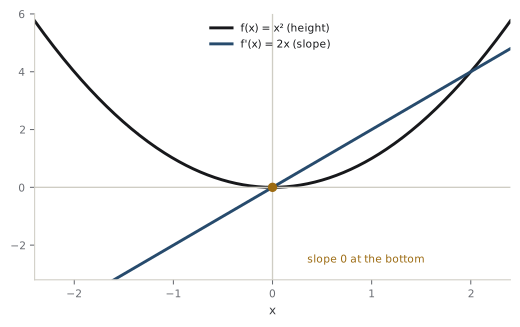
Reading a function and its derivative together, like this, is the skill the rest of Part II is built on. Every shortcut in the next chapter is really a way to get from the height-function to the slope-function without redoing the sliding-secant limit by hand every single time.
References
- Strang, G. (2010). Calculus. Wellesley-Cambridge Press.
Check yourself
A few questions to check the ideas from this chapter. Pick an answer to see whether it holds up.
-
In plain words, what does the derivative of a function at a single point measure?
The derivative is a slope, not a height and not an area. It answers 'how fast is the output changing as the input nudges forward, right here?', which is the steepness of the tangent line grazing the curve at that point. Height is just the function's value; area is what integration measures. -
We build the derivative by drawing a secant line between two points on the curve and then sliding them together. What is happening to the secant as the gap h shrinks toward zero?
Both the rise and the run shrink together, and their ratio settles on a specific number: the tangent's slope. It does not blow up (numerator shrinks too), it is not zero (the ratio is what matters, not the gap), and it never 'lands exactly' after finitely many steps — the tangent is the limit the secants approach, which is the whole point of a limit. -
The slope of the secant is (f(a+h) − f(a)) / h. Why can't we just set h = 0 to get the slope at the point?
At h = 0 both the top and the bottom are exactly zero, and 0/0 has no meaning on its own. The limit rescues the calculation by watching the ratio for tiny nonzero h and reporting the number it homes in on. It is not a mere formality, and the trouble is 0/0 specifically, not infinity. -
Once you can find the slope at every input, you can package those slopes into a new function, the derivative function f'. What does f'(3) tell you?
The derivative function is a slope-reporting machine: feed it an input, get back the original curve's steepness there. So f'(3) is the tangent slope of f at x = 3 — not f's height, not the derivative's own steepness, and not an average over an interval (that would be a single secant slope, not the derivative).