3The Limit: Getting Arbitrarily Close
You already trust limits without knowing their name. When you say a runner "closed in on" the world record, or that a cooling coffee "settles toward" room temperature, you are describing a value that something heads for — whether or not it ever quite lands there. That heading-toward is the whole idea of a limit: the single number a function approaches as its input creeps toward a target. It is the quiet engine under everything in this book, and the last chapter already leaned on it hard. When we shrank the gap \(h\) and watched the secant slopes settle onto the tangent slope, that "settle onto" was a limit. This chapter slows that motion down until it feels obvious.
If you keep one sentence, keep this: a limit is where a function is headed, which is not always the same as where it lands.
3.1Approaching without arriving
Picture a function as a road and its graph as the scenery you drive past. To ask for a limit is to ask a very physical question: as you drive toward a particular spot on the road, what value is the scenery closing in on? You are not asking what happens at the spot. You are asking what the trip promises as you get near it.
Here is the catch that makes limits worth their own chapter. You can approach a spot from two directions, and an honest answer has to agree from both. Coming from the left means letting the input rise toward the target from below — inputs like \(0.9\), then \(0.99\), then \(0.999\). Coming from the right means letting it fall toward the target from above — \(1.1\), then \(1.01\), then \(1.001\). Each of these is a one-sided limit: the value the function approaches as the input closes in from just that one side. When the left and the right answers match, that shared number is the limit.
Intuition
A limit is the value both sides of the approach agree on. If the left-hand journey and the right-hand journey are heading for the same number, that number is the limit — no matter what, if anything, sits exactly at the target.
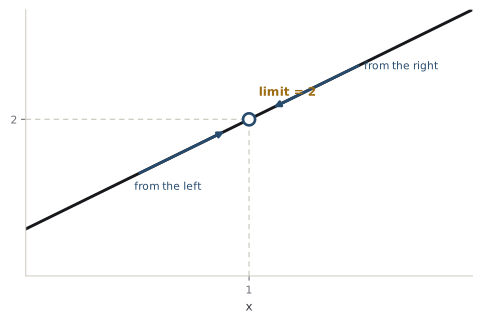
Let us make the two-sided approach something you can feel. Take the function \(\frac{x^2 - 1}{x - 1}\), and aim for the target \(x = 1\). That input is forbidden: plug in \(1\) and you get \(\frac{0}{0}\), which is meaningless, so the function has no value there at all — a hole in its graph. But near \(1\) the function is perfectly well behaved. In fact a little algebra shows why: \(x^2 - 1\) factors as \((x-1)(x+1)\), so for every input except the forbidden one,
Everywhere but \(x = 1\), this is just the tame line \(x + 1\). So as you slide the input toward \(1\) from the left, the output climbs toward \(2\); slide in from the right, and it drops toward \(2\). Both sides agree. The output homes in on \(2\) even though the function never actually reaches the spot where it would equal \(2\).
Now we can name the thing in symbols. The sentence "as \(x\) approaches \(1\), the function approaches \(2\)" is written
Read the little "\(\lim\)" as "the value approached by," and read "\(x \to 1\)" as "as \(x\) heads toward \(1\)." The arrow is doing the work: it says approach, never arrive. Nothing in that notation claims the function has a value at \(1\) — it only reports where the function is pointed as you get close.
Analogy
Think of walking toward a doorway you will never step through. From the hall you can say with total confidence which room you are heading into, long before you reach the threshold — and you would give the same answer whether you came down the left corridor or the right. The limit is the room you are heading into. Where the analogy leaks: a real doorway is a real place you could stand, whereas a limit can point at a spot the function flatly refuses to occupy, like our hole at \(x = 1\).
3.2The limit versus the value at a point
The hole forces a distinction that is the beating heart of this chapter, so let us say it slowly. There are two entirely separate questions you can ask about a function at an input \(a\):
- What is the value? — literally \(f(a)\), what you get by plugging in.
- What is the limit? — \(\lim_{x \to a} f(x)\), the value the function approaches near \(a\).
Most of the time these agree, which is exactly why they are so easy to confuse. But they are different questions, and our hole is the clean case where they part ways: the limit as \(x \to 1\) is \(2\), while the value at \(1\) does not exist at all. A hole like this, where the limit exists but the function is missing or misplaced at the single target point, is called a removable discontinuity — "removable" because you could patch it by simply defining the function to equal its own limit there, filling the hole with a single dot.
Common trap
A limit is not a fancy way of saying "plug in the number." Plugging in works only when the function happens to be continuous at that point, which is a fact you have to earn, not assume. Our example is the proof: plugging \(x = 1\) into \(\frac{x^2 - 1}{x - 1}\) gives the meaningless \(\frac{0}{0}\), yet the limit is a perfectly definite \(2\). The limit ignores the single target point on purpose and reads only the neighborhood around it.
This is also why the last chapter needed limits at all. The secant-slope formula \(\frac{f(a+h) - f(a)}{h}\) collapses to \(\frac{0}{0}\) the instant you set the gap \(h\) to zero — the same dead end as our hole. The derivative escapes it the same way we just did: not by plugging in the forbidden value, but by asking what the ratio approaches as \(h\) shrinks. The tangent slope is a limit of secant slopes, full stop. Everything in Chapter 5 rests on the move you are learning here.
Wait, why?
Why should we care what a function approaches at a point where it isn't even defined? Because the questions calculus actually asks all live at exactly those forbidden points. "How fast am I going at this instant?" and "what is the slope right here?" both reduce to a \(\frac{0}{0}\) that has no value at the target but a crisp value nearby. If limits only told us things at points where we could already just plug in, they would tell us nothing we didn't know. Their whole power is that they speak precisely where plugging in falls silent.
Note
"Removable" is about the limit, not about ease of repair in the wild. It means the two-sided limit exists, so a single well-chosen value would make the function continuous there. The breaks in the next section are not removable: no single dot can patch them, because there is no one value for both sides to agree on. Continuity — the property of a function whose limit and value agree everywhere, so you can draw it without lifting your pen — gets its own treatment in Chapter 4.
3.3When limits misbehave
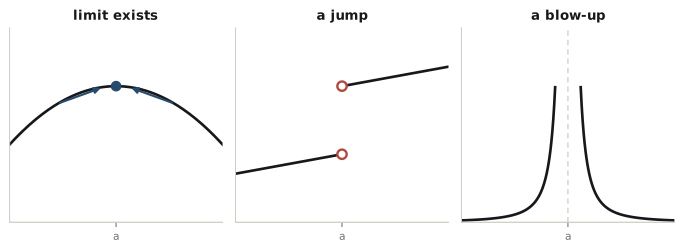
A limit is a promise that both sides of an approach agree on a single finite number. Break that promise and the limit fails to exist — and there are two classic ways to break it, both easy to read straight off a graph.
The first is a jump. Here the left-hand approach and the right-hand approach are each perfectly well behaved on their own, but they head for different numbers. Imagine a parking garage that charges a flat rate that steps up on the hour: a hair before the hour the price is heading for one figure, a hair after it is heading for a higher one. Both one-sided limits exist; they simply disagree. Since there is no single value both sides endorse, the two-sided limit does not exist. This is the tell-tale sign that a discontinuity is not removable — you cannot patch a gap with one dot when the two edges of the gap sit at different heights.
The second is a blow-up. Here at least one side does not settle on any finite number at all — the output grows without bound as the input closes in, racing off toward \(+\infty\) or \(-\infty\). We say the function diverges to infinity. Think of \(\frac{1}{(x-1)^2}\) as \(x\) nears \(1\): the denominator shrinks toward zero while the top stays at \(1\), so the fraction explodes upward past any ceiling you name. "\(\infty\)" is not a number the function is approaching; it is shorthand for "there is no finite limit, and here is the way it fails — by escaping upward."
Wait, why?
If the function shoots off to infinity, why not just say the limit "is" infinity and move on? Because "the limit exists and equals \(L\)" means the function settles down near one finite number \(L\), and a blow-up does the opposite of settling — it runs away. Writing \(\lim = +\infty\) is a useful description of how the limit fails, not a claim that it succeeded. Keeping that honest matters: a value that actually converges and a value that escapes to infinity behave nothing alike, and calculus treats them very differently (Strang, 2010).
Intuition
A two-sided limit exists only when both sides agree on the same finite number. A jump fails the agree part; a blow-up fails the finite part. Everything else is bookkeeping.
Reading these three outcomes off a graph — clean approach, jump, blow-up — is the skill the next two chapters run on. Chapter 4 turns "the limit and the value agree here" into the precise idea of continuity, and Chapter 5 turns "the limit of the secant slopes" into the derivative. Both are just this chapter's approaching-without-arriving, pointed at a new question.
References
- Strang, G. (2010). Calculus. Wellesley-Cambridge Press.
Check yourself
A few questions to check the ideas from this chapter. Pick an answer to see whether it holds up.
-
For the function (x squared minus 1) divided by (x minus 1), what is the limit as x approaches 1, and what is the function's value at x equals 1?
Away from x equals 1, the expression simplifies to x plus 1, which heads to 2 as x nears 1 from both sides, so the limit is 2. But plugging in x equals 1 gives zero over zero, which is undefined, so the function has no value there — a hole. The zero-over-zero answer is the classic trap: it tells you plugging in fails, not that the limit fails. The limit reads the neighborhood, not the point. -
A function's left-hand limit at x equals 3 is 5, and its right-hand limit at x equals 3 is 5, but the function is actually defined to equal 9 at x equals 3. What is the two-sided limit as x approaches 3?
The limit depends only on where the two sides are heading, and both are heading for 5, so the limit is 5 — the value plunked down at the point is irrelevant to it. This is a removable discontinuity: the limit exists even though the value is misplaced, and redefining the point to be 5 would patch it. Choosing 9 is the trap of confusing the value with the limit; they are separate questions. -
At x equals 2, a function approaches 4 from the left and approaches 7 from the right. Which statement is correct?
Each side settles on a definite number, so both one-sided limits exist — 4 on the left, 7 on the right. But a two-sided limit requires the two sides to agree, and 4 is not 7, so it does not exist. This is a jump, and it is why a jump is not removable: no single dot can sit at two different heights at once. -
As x approaches 1, the function 1 divided by (x minus 1) squared grows larger and larger without bound. What is the most accurate way to describe the limit?
Saying a limit exists and equals L means the function settles near one finite number, and a blow-up does the opposite — it runs away past every ceiling. Writing 'equals infinity' is shorthand for how the limit fails, not a claim that it succeeded; infinity is not a number the output closes in on. The denominator does shrink toward zero, but one over a tiny positive number is enormous, not zero. -
Why can't you find the limit of a secant slope by simply setting the gap h to zero in the difference quotient?
At h equals zero the difference quotient becomes the height at the point minus itself, over zero — zero over zero, which could be anything. The limit sidesteps this by never touching h equals zero; it reads the trend of the ratio for small nonzero gaps. This is exactly the hole situation, and it is why the derivative in Chapter 5 is built as a limit rather than a plug-in. -
Which single condition guarantees that a two-sided limit exists at a point?
A two-sided limit exists exactly when both sides agree on one finite value — that is the whole definition. Being defined at the point is neither necessary nor sufficient: the hole example has a limit with no value, and the jump example can have a value with no limit. And both sides existing is not enough if they disagree, as a jump shows; they must match.