7Function and Property Prediction
A model that reads one molecule and predicts a number you could otherwise get only from an experiment: how tightly a drug candidate binds, whether a point mutation cripples an enzyme, how well a protein survives being heated, how much of it a cell will actually express. That is property prediction. The molecule is given — you are not searching for a new one, as in design (Chapter 9), and you are not folding it, as in structure (Chapter 8). You want a property, and you want it cheaply, before the assay (Chapter 4) that would measure it for real. The central bet of this chapter is that the same protein language models that learned sequence statistics can score properties they were never explicitly trained on, and that when you do have labels, a small supervised head on top does even better.
7.1The problem: from sequence to phenotype
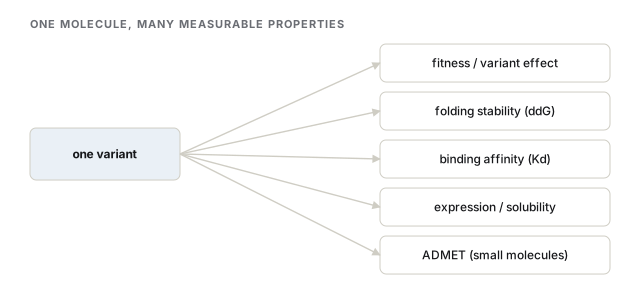
Property prediction takes a single molecule and returns a measurable quantity. For proteins the workhorse quantities are: variant effect or fitness (how much a mutation helps or hurts function), folding stability (the free-energy change on mutation, written ΔΔG, where a positive value means destabilizing), binding affinity (typically a dissociation constant Kd — smaller means tighter), and expression / solubility (whether the cell makes usable protein at all). For small molecules the analogous bundle is ADMET — absorption, distribution, metabolism, excretion, and toxicity — the pharmacological properties that decide whether a promising binder can ever become a drug.
Why bother predicting these instead of measuring them? Scale. Deep mutational scanning (DMS), an assay that measures the functional effect of thousands to millions of variants of one protein in a single experiment, is powerful but still bounded by what one lab can build. A model that generalizes from a few such experiments can score every possible variant of a protein in seconds, turning a wet-lab screen into a ranked shortlist. That shortlist feeds target discovery (Chapter 6), where you ask which variants of a gene are damaging, and it feeds engineering, where you ask which mutations to try next.
Intuition
A property predictor is a cheap, noisy stand-in for an assay: worth running when it reorders your candidates well enough that the top of its list is enriched for real hits, even if its individual numbers are wrong.
Collaborator
Which of my assays can this actually replace? None of them, yet. Treat it as a prioritizer that tells you which 50 of your 5,000 variants to measure first. The model earns its place if the wet-lab hit rate in its top-ranked slice is meaningfully above the background rate, not by matching your assay's numbers.
7.2Models that attempt it
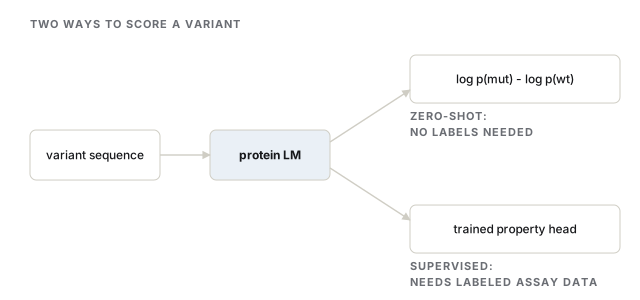
Two families do the work, and they map onto the model families from the ML on-ramp (Chapter 3). The first is zero-shot scoring with a protein language model — zero-shot meaning no task-specific labels are used at all. A masked language model like ESM-2, or an autoregressive one like ProGen2, is trained only to predict amino acids from sequence context across UniRef-scale data, and in doing so it learns which sequences look "natural" (Rives et al., 2021). To score a mutation you compare how probable the model finds the mutant residue versus the wild-type residue at that position: the log-likelihood ratio (LLR), log p(mutant) − log p(wild type). A large negative score means the model thinks the substitution is unlike anything evolution kept. This is the ESM-1v recipe (Meier et al., 2021).
The idea that likelihood tracks fitness rests on a real mechanism: natural sequences are the survivors of selection, so residues that would break function were removed from the training data, and the model assigns them low probability. The community benchmark is ProteinGym, a suite of 217 DMS assays covering millions of variants against which methods are scored by Spearman rank correlation to measured fitness (Notin et al., 2023). On it, single-sequence PLMs land around 0.4–0.5 average Spearman (ESM-1v and ESM-2 650M are essentially tied there), and — worth internalizing — they do not dominate. Methods that exploit a multiple sequence alignment (MSA), the stack of evolutionarily related sequences for a protein, remain competitive or better: the alignment-based GEMME and hybrids like TranceptEVE cluster near the top, and AlphaMissense, an AlphaFold derivative fine-tuned on population variant frequencies, is state of the art for human missense pathogenicity (Cheng et al., 2023). Recent analyses even suggest single-sequence PLM likelihood is hitting a scaling plateau on this task.
The second family is supervised: when you have labeled measurements for the exact property you care about, take the PLM's per-residue embeddings and train a regression head on them. This wins whenever labels exist. The clearest case is stability: the Tsuboyama megascale dataset measured folding stability for ~776,000 domain variants by proteolysis (Tsuboyama et al., 2023), and models fine-tuned on it — ThermoMPNN — reach Spearman around 0.72; note that the strongest stability predictors read the 3D backbone (ThermoMPNN builds on ProteinMPNN) rather than sequence-PLM embeddings on held-out stability, far above any zero-shot likelihood (Dieckhaus et al., 2024). For small-molecule ADMET the same pattern holds without a language model at all: graph neural networks trained on the Therapeutics Data Commons benchmarks (Huang et al., 2021), as in ADMET-AI, are the practical default (Swanson et al., 2024).
Common trap
Likelihood-as-fitness measures evolutionary plausibility, not your objective. A residue that is conserved because it stabilizes the fold will score well even if you are trying to improve catalytic rate or binding to a non-natural target. The model tells you a variant looks like a real protein, not that it is a better one for your purpose.
7.3What they do well and what is still hard
These models are genuinely useful at what they are for: ranking single substitutions, flagging likely-deleterious mutations, and pre-screening a large variant library down to a testable set. Where they struggle traces to a few recurring failures.
Off-distribution generalization. PLMs are anchored to natural sequence space, so they extrapolate poorly to de novo or heavily engineered proteins that no longer resemble anything in UniRef — exactly the regime protein design (Chapter 9) operates in. The plateau in single-sequence performance on ProteinGym is a symptom: more parameters stop helping once the model has absorbed the evolutionary signal there is to absorb.
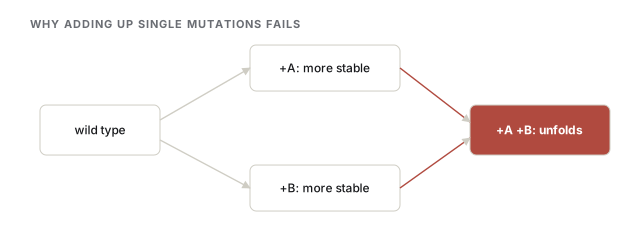
Epistasis. The effect of two mutations is often not the sum of their individual effects, and likelihood-based scores, computed largely per position, miss these higher-order interactions. In reciprocal sign epistasis, two individually beneficial mutations combine to break the protein — the case that most punishes an additive predictor.
Calibration. Scores rank well but are not calibrated probabilities, and the useful decision threshold shifts from protein to protein. An LLR of −5 may mean "dead" for one enzyme and "mildly worse" for another, so a fixed cutoff over-flags on some proteins and under-flags on others.
Fitness versus the activity you care about. This is the deepest gap. Likelihood and stability are correlated with function broadly, but the specific number you want — a catalytic turnover, selectivity between two targets, an off-target toxicity — is a narrow slice that generic evolutionary plausibility does not resolve. Closing that gap is what the design–build–test loop (Chapter 17) is for, and it is why property models augment rather than replace experiments.
Collaborator
A Spearman of 0.5 sounds mediocre — is it good enough to act on? For picking values, no; for ordering candidates, often yes. What matters operationally is enrichment: if the top 5% of the ranked list contains several-fold more true hits than random, the model has already paid for itself, even though its per-variant predictions are too noisy for a calibrated decision.
For interpreting human variants specifically — pathogenic or benign rather than fitness in a dish — the framing shifts toward mechanism and population genetics, which is the subject of variant-to-mechanism (Chapter 13); the single-cell foundation models that predict expression phenotypes are covered lightly in the appendix.
References
- Cheng, J., Novati, G., Pan, J., Bycroft, C., Žemgulytė, A., Applebaum, T., Pritzel, A., Wong, L. H., et al. (2023). Accurate proteome-wide missense variant effect prediction with AlphaMissense. Science.
- Dieckhaus, H., Brocidiacono, M., Randolph, N. Z., & Kuhlman, B. (2024). Transfer learning to leverage larger datasets for improved prediction of protein stability changes. PNAS.
- Huang, K., Fu, T., Gao, W., Zhao, Y., Roohani, Y., Leskovec, J., Coley, C. W., Xiao, C., Sun, J., & Zitnik, M. (2021). Therapeutics Data Commons: Machine Learning Datasets and Tasks for Drug Discovery and Development. NeurIPS Datasets and Benchmarks. arXiv:2102.09548.
- Meier, J., Rao, R., Verkuil, R., Liu, J., Sercu, T., & Rives, A. (2021). Language models enable zero-shot prediction of the effects of mutations on protein function. NeurIPS.
- Notin, P., Kollasch, A. W., Ritter, D., van Niekerk, L., Paul, S., Spinner, H., Rollins, N., Shaw, A., et al. (2023). ProteinGym: Large-Scale Benchmarks for Protein Fitness Prediction and Design. NeurIPS Datasets and Benchmarks Track.
- Rives, A., Meier, J., Sercu, T., Goyal, S., Lin, Z., Liu, J., Guo, D., Ott, M., Zitnick, C. L., Ma, J., & Fergus, R. (2021). Biological structure and function emerge from scaling unsupervised learning to 250 million protein sequences. Proceedings of the National Academy of Sciences.
- Swanson, K., Walther, P., Leitz, J., Mukherjee, S., Wu, J. C., Shivnaraine, R. V., & Zou, J. (2024). ADMET-AI: a machine learning ADMET platform for evaluation of large-scale chemical libraries. Bioinformatics.
- Tsuboyama, K., Dauparas, J., Chen, J., Laine, E., Mohseni Behbahani, Y., Weinstein, J. J., Mangan, N. M., Ovchinnikov, S., et al. (2023). Mega-scale experimental analysis of protein folding stability in biology and design. Nature.
Check yourself
Questions a sharp collaborator might ask on this chapter. Pick an answer to see whether it holds up.
-
Why does a protein language model's log-likelihood ratio predict variant fitness at all, given that it never saw fitness labels?
The likelihood-as-fitness bet works because the training corpus is filtered by evolution: harmful residues were purged, so the model assigns them low probability. That is why the signal exists without labels, and also why it tracks broad evolutionary plausibility rather than any one engineering objective. -
On ProteinGym, how do single-sequence protein language models compare to alignment-based methods for zero-shot variant effect?
Single-sequence PLMs cluster near 0.4 to 0.5 average Spearman and do not dominate; alignment-based GEMME and hybrids like TranceptEVE, plus AlphaMissense, remain at or above them. Both approaches are label-free, and single-sequence performance appears to be plateauing rather than pulling ahead with scale. -
You add up a protein language model's single-mutant scores to predict a double mutant and get it badly wrong. What is the most likely cause?
Higher-order interaction, especially sign epistasis, means the combined effect is not the sum of parts, and per-position likelihood scores largely miss it. Calibration is a separate problem about absolute magnitudes; the failure here is the additive assumption itself. -
You have 20,000 labeled folding-stability measurements for your protein family. What is the strongest approach to predict stability for new variants?
When labels for the exact property exist, a supervised head on learned features wins: models trained on the megascale stability data reach roughly 0.72 Spearman, far above zero-shot likelihood. Likelihood measures evolutionary plausibility, which correlates with but does not equal folding stability. -
A variant-effect model reaches Spearman 0.5 against a DMS assay. What decision does that most justify?
A moderate rank correlation supports ordering candidates, not calibrated numbers: what matters operationally is top-k enrichment over the background hit rate. It does not license precise per-variant values or clinical classification, and it complements rather than replaces the assay.