22Agents
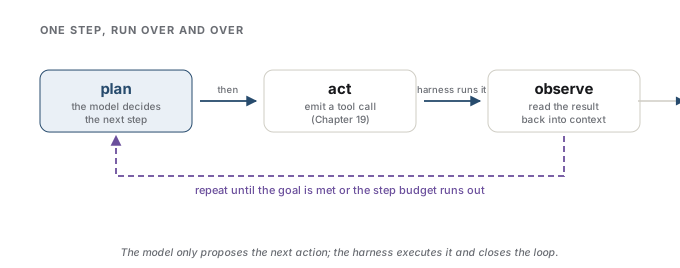
An agent is a model placed in a loop. Instead of answering a prompt once and stopping, it plans a step, takes an action — usually a tool call (Chapter 19) — observes what came back, and decides what to do next, repeating until the goal is met or a budget runs out. Nothing about the model changes; what changes is that the harness keeps handing it back its own consequences. That single shift, from one-shot generation to a controlled loop, is the whole idea, and almost everything hard about agents follows from the loop being long.
22.1The loop is the whole idea
Strip an agent down and you find a cycle the harness runs: the model plans (decides what to do), acts (emits an action the harness can execute), and observes (the harness runs the action and feeds the result back into the context). The model is the controller; the harness is the interpreter that closes the loop. A weather assistant that calls one API and answers has run the loop once. A coding agent that reads files, edits them, runs the tests, reads the failures, and edits again has run it thirty times.
The important correction to make early is that autonomy is a spectrum, not a binary. At one end sits a fixed workflow: the control flow is written in code, and the model fills slots along a predetermined path — classify, then route, then summarize. At the other end sits an open-ended agent that decides its own path, including how many steps to take and which tools to use. Anthropic draws exactly this line and gives the load-bearing advice: use the simplest thing that passes your eval, and reach for an autonomous agent only when you genuinely cannot hardcode the path (Anthropic, 2024). Most production "agents" are mostly workflow with a small autonomous core.
Intuition
An agent is not a smarter model. It is the same next-token predictor from Chapter 4, given a scratchpad, a set of tools, and permission to keep going until it decides it is done.
Interview
When would you build a workflow instead of an agent? Whenever the task's steps are known in advance. If you can draw the flowchart, code the flowchart: it is cheaper, faster, and far easier to test, because every path is fixed. Autonomy earns its cost only when the path depends on inputs you cannot see ahead of time — an open-ended research question, a debugging session — where you can still verify progress even though you cannot script it. The failure mode is reaching for a general agent where a three-step chain would do, and paying in latency and unpredictability for flexibility you never use.
22.2Planning and memory
A long loop needs two things a single forward pass does not: a way to break a goal into steps, and a way to remember more than fits in the context window.
Planning starts with decomposition — turning "book me a trip" into find flights, compare, hold a fare, book a hotel. The most influential recipe for interleaving this with action is ReAct, which has the model alternate a reasoning trace with an action (Yao et al., 2023). The reasoning step lets it form and revise a plan and handle surprises; the action step lets it pull real information from the world instead of inventing it, which measurably curbs the hallucination that pure chain-of-thought drifts into. The two are complements: thinking without acting invents facts, acting without thinking flails.
Memory comes in two tiers. The model's own reasoning is a scratchpad — working memory that lives entirely inside the context window, so it is bounded by the window and wiped between separate sessions. To remember across that boundary, an agent writes to external memory: a file, a database, a scratchpad it re-reads, or a vector store it retrieves from exactly as in RAG (Chapter 21). The generative-agents work made this concrete with a memory stream that stores observations in natural language and retrieves the relevant ones on demand (Park et al., 2023). External memory is how an agent's effective horizon exceeds its context length.
The subtlest tool here is reflection: after a failure, the agent writes down what went wrong in words and keeps that note for the next attempt. Reflexion turns this into a learning signal without any weight update — the agent verbally critiques its last trajectory, stores the critique in episodic memory, and does better on the retry (Shinn et al., 2023). The honest caveat, and the second question an interviewer asks, is that reflection only helps when the feedback is trustworthy: with a real signal like a failing test or a compiler error it works well, but asking a model to grade its own reasoning with no external check can just as easily launder a wrong answer into a confident one.

22.3More agents, or just more cost?
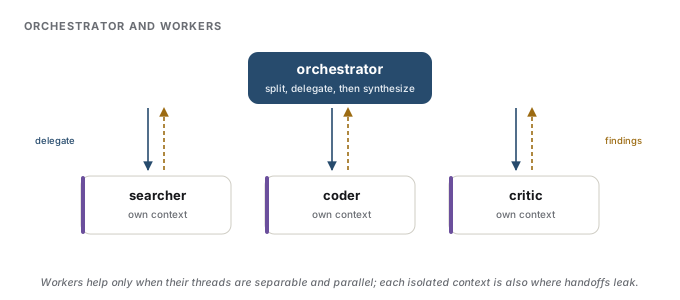
Once one agent works, the temptation is to build many. The dominant pattern is orchestrator–worker: a lead agent decomposes the task, spawns worker agents (often specialists — a searcher, a coder, a critic), and synthesizes their results. The workers can run in parallel, each with its own context window.
The question that matters is when this genuinely helps. It helps when subtasks are separable and parallel — a breadth-first research question where independent threads can be chased at once and the total information gathered would overflow a single context window. Anthropic's research system is the canonical case: parallel subagents, each with a fresh context, beat a single agent on breadth-heavy queries, but at roughly fifteen times the token cost of a normal chat (Anthropic, 2025). That ratio is the whole tradeoff in one number. Multi-agent pays off only when the value of the answer dwarfs the token bill.
It hurts when tasks are sequential or tightly coupled. Then the agents cannot work in parallel, and every handoff is a chance to lose context: worker B does not see what worker A saw, so it duplicates work, contradicts a decision, or acts on a stale assumption. More agents multiply the token cost and the error surface, and the coordination itself becomes a source of bugs. A single well-tooled agent with a long context often beats a committee.
Analogy
Think of it as staffing a project. Independent research strands parallelize across people beautifully; a delicate sequential negotiation does not, because context lost in the handoff between two people is context the work depended on. The analogy leaks in that human teammates share a persistent mental model and can interrupt each other to sync, while subagents share only the text you explicitly pass between them.
Interview
Your multi-agent system is slower and worse than the single agent it replaced — why? Almost always because the subtasks were not actually independent. Coordination overhead and lossy handoffs only pay off when workers explore genuinely parallel branches; on a sequential task you have added latency, token cost, and failure modes while removing the shared context that a single agent kept for free. Reach for multiple agents for parallel breadth, not to make one hard sequential task feel more organized.
22.4Why agents are hard
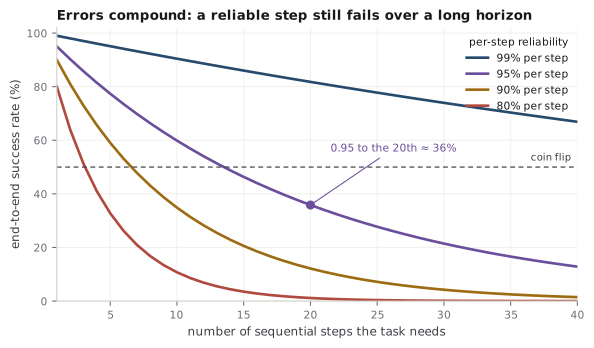
The defining difficulty of agents is arithmetic. If each step succeeds with probability \(p\), a task requiring \(n\) independent correct steps succeeds with about \(p^n\). At a strong-sounding 95% per step, twenty steps land at \(0.95^{20} \approx 0.36\) — worse than a coin flip. Errors compound, and long horizons punish even reliable models, which is why 2026's agents are impressive on tasks of a few dozen steps and fragile on tasks of hundreds. Reflection and verification claw some of this back by catching errors before they propagate, but they do not repeal the exponent.
Three more difficulties ride alongside. Evaluation is genuinely hard: a task has many valid trajectories, partial progress resists scoring, and a run that reaches the right answer by a lucky wrong path should not really count as success — Chapter 24 takes this up. Cost and latency scale with the loop: every step is a full generation plus a tool round-trip, so an agent that "thinks" for fifty steps is fifty times the bill and the wall-clock of one answer. And security is the sharpest edge. An agent that browses the web and takes actions is a standing target for prompt injection (Chapter 18): a malicious instruction hidden in a page or a document the agent reads can hijack its plan and turn its tools against the user. The danger concentrates when three things meet — access to private data, exposure to untrusted content, and the ability to communicate outward — because that combination lets an injection exfiltrate what it should not. Chapter 23 treats the defenses; the point here is that autonomy and attack surface grow together.
Common trap
Demos mislead because they show the trajectories that worked. A per-step success rate estimated from cherry-picked runs hides the compounding that dominates real usage, and an agent that clears a curated benchmark can still fail most long real tasks. Measure end-to-end success on the full horizon you actually deploy, not the reliability of a single step.
The sober 2026 read: agents are real and useful where the loop is short, the tools are reliable, and a human or a hard check sits in the loop — coding assistants, research and browsing, structured data work. They remain brittle wherever the horizon is long, the reward is unverifiable, or the environment is adversarial. The frontier (Chapter 25) is pushing per-step reliability and horizon length up together, because only both at once moves the exponent.
References
- Anthropic (2024). Building effective agents. Anthropic engineering blog.
- Anthropic (2025). How we built our multi-agent research system. Anthropic engineering blog.
- Park, J. S., O'Brien, J. C., Cai, C. J., Morris, M. R., Liang, P., & Bernstein, M. S. (2023). Generative agents: Interactive simulacra of human behavior. ACM Symposium on User Interface Software and Technology. arXiv:2304.03442.
- Shinn, N., Cassano, F., Berman, E., Gopinath, A., Narasimhan, K., & Yao, S. (2023). Reflexion: Language agents with verbal reinforcement learning. Advances in Neural Information Processing Systems. arXiv:2303.11366.
- Yao, S., Zhao, J., Yu, D., Du, N., Shafran, I., Narasimhan, K., & Cao, Y. (2023). ReAct: Synergizing reasoning and acting in language models. International Conference on Learning Representations. arXiv:2210.03629.
Check yourself
Interview-style questions on this chapter. Pick an answer to see whether it holds up.
-
You are deciding between a fixed workflow (steps written in code, the model filling slots) and an autonomous agent (the model chooses its own path) for a task whose steps are the same every time. Which choice fits, and why?
Autonomy is a spectrum, and it earns its cost only when the path depends on inputs you cannot see ahead of time. If you can draw the flowchart, code it: fixed paths are cheaper and testable. Workflows call tools perfectly well, and agents do maintain state, so those are not the reasons; the real distinction is who decides the control flow. -
Each step of an agent's loop succeeds independently with probability 0.95. A task needs 20 such steps in sequence. Roughly what is the end-to-end success rate, and what does it imply?
For independent steps the success rate is p^n, and 0.95^20 is about 0.36. The tempting 90% treats failures as additive rather than multiplicative. This exponent is why 2026 agents shine on tasks of a few dozen steps and grow fragile over hundreds; reflection and verification claw some back but do not repeal it. -
In the ReAct pattern, the model interleaves a reasoning trace with actions rather than reasoning first and acting later. What does the interleaving buy that pure chain-of-thought does not?
Interleaving grounds the plan: an action fetches a fact from the environment, and the following thought has to reconcile with it, so the model invents less. It does not remove reasoning, guarantee optimal paths, or relocate reasoning out of context. Thinking without acting invents facts; acting without thinking flails. -
A team replaces a single well-tooled agent with an orchestrator that spawns several worker agents. The task is a sequence of tightly coupled steps. The new system is slower and less accurate. What is the most likely cause?
Multiple agents pay off only when threads are separable and parallel; on sequential, coupled work you add coordination overhead and lossy handoffs while removing the shared context a single agent kept for free. Workers typically have separate contexts, not one shared one, and token cost alone is not what broke it. -
Reflexion has an agent write a verbal critique of its failed attempt, store it in memory, and retry. When is this self-reflection most likely to backfire?
Reflection improves next-try behavior when the feedback is trustworthy, such as a failing test or a compiler error. With no external check, self-grading can launder a wrong answer into a confident one. Concrete signals help rather than hurt, and persisting critiques is the mechanism by which it works, not a defect. -
Why is an agent that browses the web and takes actions considered a prompt-injection magnet in a way a plain chatbot is not?
The danger concentrates when access to private data, exposure to untrusted content, and the ability to act or communicate outward all meet: a malicious instruction hidden in a page can then redirect the agent's tools. Context length does not reorder instruction priority, temperature is unrelated, and tool output is input, not training data. Chapter 23 covers the defenses.