12Preference Optimization Without RL
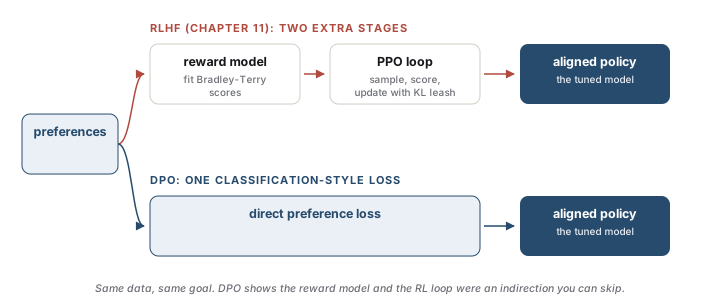
Chapter 11 aligned a model the hard way: fit a reward model to human preferences, then chase that reward with reinforcement learning. It works, and frontier labs still run it, but it is a heavy machine — a second network to train, a full RL loop to babysit, and a reward signal you can over-optimize. This chapter is the counter-argument. It turns out the preference data can train the policy directly, with an ordinary supervised loss and no reward model in sight. That reframing, Direct Preference Optimization, is the default alignment recipe for most teams in 2026, and the family of variants around it is a map of what alignment actually needs.
12.1DPO: skipping the reward model
Start from the exact objective Chapter 11 optimized: maximize reward while a KL penalty keeps the policy close to the reference (the SFT model). That objective has a known closed-form solution — the optimal policy is the reference reweighted by the exponentiated reward. DPO's move is to read that equation backwards (Rafailov et al., 2023). If the optimal policy is a function of the reward, then the reward is a function of the policy:
The reward is implicit — it is just how much more likely the policy makes a response than the reference does. Substitute this into the Bradley-Terry preference model from Chapter 11, and the awkward normalizing term cancels between the chosen and rejected responses. What remains is a plain classification loss on preference pairs \((x, y_w, y_l)\):
Read it in words: push up the log-probability of the winner, push down the loser's, and measure both against a frozen reference so the model cannot cheat by inflating everything. No reward model, no sampling loop — one forward pass over a fixed dataset, trained like any classifier.
Intuition
The reward model was never the point; it was a middleman between preferences and the policy. DPO cuts the middleman and lets the preference pairs adjust the policy's own token probabilities.
Interview
If there is no reward model, what is \(\beta\) doing, and why keep the reference model at all? \(\beta\) is the same KL leash from PPO, now baked into the loss: it sets how far the policy may move from the reference per unit of preference. The reference appears in every term as the anchor the log-ratio is measured against — drop it and the loss rewards raising the winner's probability without bound, which degrades fluency fast. The gradient also self-weights: pairs the implicit reward already gets wrong push hardest, so DPO spends its capacity where it is currently mistaken.
12.2The DPO family: IPO, KTO, ORPO, SimPO
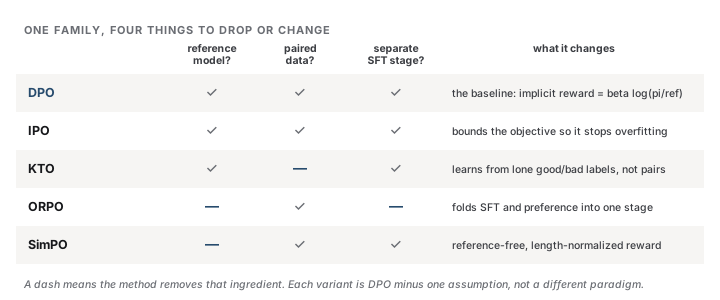
DPO makes several assumptions, and each variant relaxes one. IPO attacks overfitting: DPO's logistic loss keeps rewarding a wider and wider margin, so when preferences are near-deterministic the log-ratio runs off to extremes and the KL leash slips. IPO replaces the objective with a bounded, squared target that pins the margin to a fixed value, which regularizes without a separate early-stopping trick (Gheshlaghi Azar et al., 2024). KTO attacks the data requirement. DPO needs matched pairs; KTO, drawing on prospect theory's asymmetric treatment of gains and losses, learns from lone thumbs-up / thumbs-down labels with no pairing at all — which matters because unpaired binary feedback is far cheaper and more plentiful than curated comparisons (Ethayarajh et al., 2024).
The other two drop the reference model. ORPO folds supervised fine-tuning and preference optimization into a single stage: it adds a small odds-ratio penalty to the ordinary SFT loss, so one pass over demonstrations both teaches the format and discourages the disfavored style — no separate preference phase, no reference copy (Hong et al., 2024). SimPO keeps two responses but makes the implicit reward the length-normalized average log-probability of a sequence, plus a target margin. Dropping the reference makes it leaner, and the length normalization directly attacks DPO's best-known failure — a drift toward longer answers (Meng et al., 2024).
Common trap
DPO quietly rewards length: because it sums token log-probabilities, a longer rejected response is easier to push down, so the model learns that more tokens look preferred. Verbose DPO outputs are usually this artifact, not a genuine quality gain — length-normalized rewards (SimPO) or length-balanced data are the fix.
12.3RLHF vs. DPO in practice
The honest tradeoff is simplicity against ceiling. DPO trains like supervised learning: one loss, one model plus a frozen reference, stable and cheap. PPO holds up to four networks in memory at once — policy, reference, reward model, and value head — and RL training is famously twitchy. For most teams that settles it: DPO gets you most of the way at a fraction of the engineering cost. But the comparison hides a deeper axis. DPO is off-policy — it learns from a dataset collected once, so as training shifts the policy, it can drift into regions the preference pairs never covered, where the loss has nothing to say. PPO is on-policy: it samples fresh responses from the current model every step, so the signal always lands where the policy actually is.
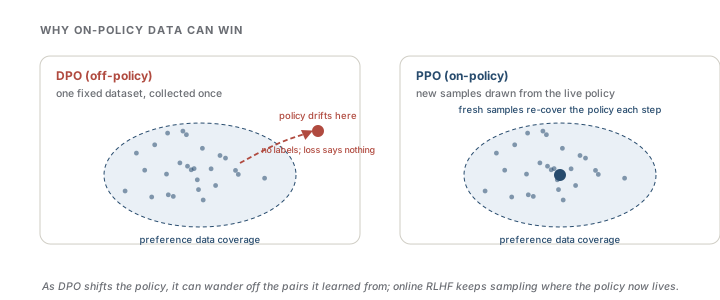
This is why "is DPO actually worse than PPO" has a nuanced answer. Careful head-to-head studies find that well-tuned PPO can beat DPO on hard benchmarks like code generation (Xu et al., 2024) — but the decisive factor is usually the data, not the algorithm: preference quality and on-policy sampling matter more than the choice of loss (Ivison et al., 2024). The practical upshot, and what an interviewer wants, is that the gap largely closes with iterative (online) DPO — regenerate fresh pairs from the current policy, relabel, and repeat — which buys back the on-policy benefit while keeping DPO's simplicity.
Interview
A team asks whether to use DPO or PPO. What do you tell them? Default to DPO for the simplicity and stability, and reach for online or iterative DPO before PPO if quality plateaus. Choose full PPO only when you have the infrastructure and a reward signal worth chasing hard — and note that in verifiable domains (math, code) the field has largely moved to on-policy RL against programmatic rewards, which sidesteps the reward-model problem entirely (Chapter 25).
12.4Constitutional AI and RLAIF
Every method so far assumes a human wrote the preference labels, which is the real bottleneck: it is slow, expensive, and caps quality at what annotators can judge. The last idea in this chapter is to let a model supply the signal. Constitutional AI runs in two phases (Bai et al., 2022). In the supervised phase, the model critiques its own response against a short written list of principles — the "constitution" — then revises it, and you fine-tune on the revisions. In the preference phase, the model plays judge: it labels which of two responses better follows the constitution, producing the exact preference pairs DPO or RLHF consumes. Because the labeler is now an LLM, the same idea generalizes to RLAIF, where AI feedback stands in for human feedback and, at least for helpfulness and harmlessness, matches it at a fraction of the cost (Lee et al., 2023).
Analogy
The constitution is like a style guide handed to a copy editor: the writer drafts, then checks each line against the rules and fixes what violates them. It leaks in that a copy editor brings outside judgment, while here the same model is author, editor, and rulebook-follower — so any blind spot it has, it applies uniformly and cannot catch in itself.
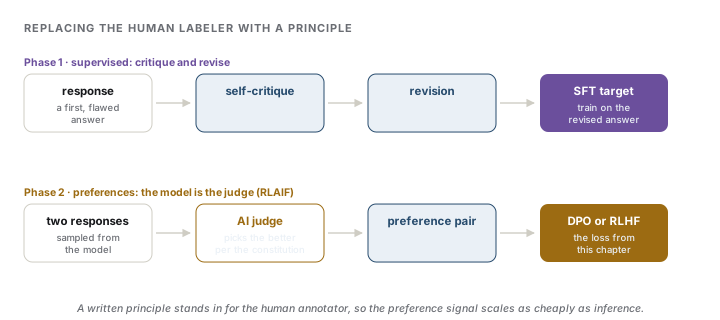
The catch is that AI feedback inherits the judge's biases and can be gamed: a policy may learn to satisfy the letter of the constitution while a human would still object, the same reward-hacking pressure Chapter 11 warned about, now aimed at a model's judgment instead of a reward model's. And it only works when the judge is capable enough to tell the responses apart — which is exactly why scaling oversight, using models to help supervise tasks that outstrip human judgment, is an open frontier (Chapters 23 and 25). Cheap preference signal is the prize; a trustworthy one is the hard part.
References
- Bai, Y., Kadavath, S., Kundu, S., Askell, A., et al. (2022). Constitutional AI: Harmlessness from AI feedback. arXiv preprint. arXiv:2212.08073.
- Ethayarajh, K., Xu, W., Muennighoff, N., Jurafsky, D., & Kiela, D. (2024). KTO: Model alignment as prospect theoretic optimization. International Conference on Machine Learning. arXiv:2402.01306.
- Gheshlaghi Azar, M., Guo, Z. D., Piot, B., Munos, R., Rowland, M., Valko, M., & Calandriello, D. (2024). A general theoretical paradigm to understand learning from human preferences. International Conference on Artificial Intelligence and Statistics. arXiv:2310.12036.
- Hong, J., Lee, N., & Thorne, J. (2024). ORPO: Monolithic preference optimization without reference model. Conference on Empirical Methods in Natural Language Processing. arXiv:2403.07691.
- Ivison, H., Wang, Y., Liu, J., Wu, Z., Pyatkin, V., Lambert, N., Smith, N. A., Choi, Y., & Hajishirzi, H. (2024). Unpacking DPO and PPO: Disentangling best practices for learning from preference feedback. Advances in Neural Information Processing Systems. arXiv:2406.09279.
- Lee, H., Phatale, S., Mansoor, H., Mesnard, T., Ferret, J., Lu, K., Bishop, C., Hall, E., Carbune, V., Rastogi, A., & Prakash, S. (2023). RLAIF: Scaling reinforcement learning from human feedback with AI feedback. arXiv preprint. arXiv:2309.00267.
- Meng, Y., Xia, M., & Chen, D. (2024). SimPO: Simple preference optimization with a reference-free reward. Advances in Neural Information Processing Systems. arXiv:2405.14734.
- Rafailov, R., Sharma, A., Mitchell, E., Manning, C. D., Ermon, S., & Finn, C. (2023). Direct preference optimization: Your language model is secretly a reward model. Advances in Neural Information Processing Systems. arXiv:2305.18290.
- Xu, S., Fu, W., Gao, J., Ye, W., Liu, W., Mei, Z., Wang, G., Yu, C., & Wu, Y. (2024). Is DPO superior to PPO for LLM alignment? A comprehensive study. International Conference on Machine Learning. arXiv:2404.10719.
Check yourself
Interview-style questions on this chapter. Pick an answer to see whether it holds up.
-
DPO is often described as training with 'no reward model.' In what sense does a reward still exist in the DPO objective?
DPO reparameterizes the RLHF reward as beta*log(pi/pi_ref). Because the optimal RLHF policy is a closed-form function of the reward, you can invert it and express the reward through the policy, then plug that into Bradley-Terry so the partition function cancels. The reward never disappears; it is just never materialized as a separate network. -
Why does DPO keep a frozen reference model in every term of its loss, rather than simply raising the probability of chosen responses and lowering rejected ones?
The reference plays the role PPO's KL penalty played: beta*log(pi/pi_ref) charges the policy for moving away from the reference. Remove it and the loss rewards inflating the winner's probability without bound, which wrecks fluency. It is an anchor, not an initializer, and it is queried on every batch. -
Users report that a DPO-tuned model gives noticeably longer answers than the SFT model it started from, without a clear gain in quality. What is the most likely cause?
This is DPO's well-known length bias: because the implicit reward is a sum of token log-probabilities, response length leaks into the signal as a confound. Length-normalizing the reward (as SimPO does) or balancing chosen/rejected lengths in the data removes the artifact; raw win-rate gains from longer outputs are usually not real quality. -
KTO differs from DPO most fundamentally in which respect?
KTO's signature is dropping the pairing requirement: grounded in prospect theory's asymmetric weighting of gains and losses, it trains on lone good/bad labels. That matters practically because unpaired binary feedback (thumbs up/down) is far more abundant than curated pairs. Merging SFT with preference is ORPO; reference-free length normalization is SimPO; on-policy sampling is PPO. -
Careful head-to-head studies of DPO and PPO have complicated the claim that one is simply better. What is the best summary of current understanding?
The empirical picture is that on-policy sampling and preference-data quality are the load-bearing factors. Vanilla DPO is off-policy and can drift off the data it learned from; iterative/online DPO recovers much of PPO's edge without the RL machinery. PPO can still win on hard tasks like code, but the algorithm name is not the main lever. -
In Constitutional AI, what specifically replaces the human labeler, and what is the main risk it introduces?
Constitutional AI substitutes a short written constitution for the human annotator: the model self-critiques and revises against it (supervised phase) and judges its own samples against it (preference phase, the RLAIF idea). The signal scales as cheaply as inference, but it inherits the judge's blind spots and can be reward-hacked to satisfy the letter of the rules, which is why scaling trustworthy oversight is still open.