20Structured Output
A model's native output is a stream of tokens meant for a human to read. A program cannot read prose. When the model's answer has to flow into a database write, a function call, or another service, "reads well" is the wrong bar — the output has to parse, every time, as a specific shape the caller agreed to in advance. This chapter is about closing that gap. The reliable way to get machine-readable output is not a better-worded request; it is to change how the model decodes, so an invalid answer becomes impossible rather than merely unlikely.
20.1Free text is not an API
The first thing everyone tries is to ask.
You append "reply with a JSON object with fields name and age" to the prompt and hope.
This works surprisingly often, and it fails often enough to be dangerous.
The model wraps the object in an apology, adds a trailing comma, emits age: "twelve" instead of a number, or fences the whole thing in a Markdown code block your parser does not expect.
Each of those is a parse error, and each parse error costs you a retry: another full forward pass, more latency, more money, and no guarantee the second try is any better than the first.
Call this the prompt-and-pray tax.
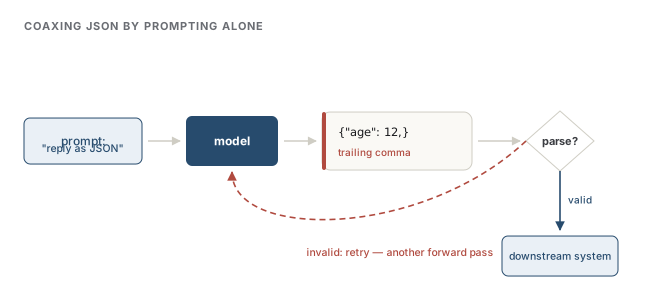
The tax is easy to miss because it scales with things you only meet in production. A 1% failure rate is fine in a demo and unacceptable when you make millions of calls a day, or when the output feeds a chain of tool calls where a single malformed argument derails everything after it. Prompting also fights itself: the same instructions that pin down the format crowd out the room the model has to actually think, a tension we return to at the end of the chapter.
Interview
Your service asks for JSON in the prompt and gets valid JSON 99% of the time. Why is that not good enough? Because the 1% is not random noise you can average away — it clusters on the hard, long, or unusual inputs you most need to handle, and every failure forces a retry that doubles cost and latency for that request. Worse, "99% valid JSON" says nothing about whether the schema is right: the object can parse cleanly and still have the wrong field names or types. Validity you can measure after the fact is not the same as validity you can guarantee before you ship a token.
20.2Constrained decoding: validity by construction
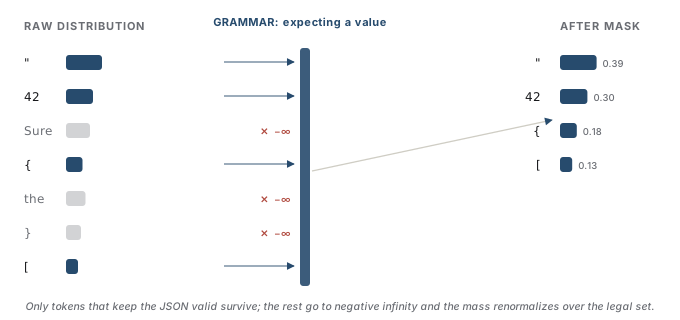
The fix is to stop hoping and start forbidding. Recall from Chapter 14 that the model does not emit text; at each step it emits a distribution over the vocabulary, and the decoder turns that distribution into a token. Constrained decoding inserts one operation just before the token is chosen: given the target format and everything generated so far, it computes the set of tokens that could legally come next, and sets the logit of every other token to \(-\infty\).
After the softmax, the forbidden tokens carry probability exactly zero, so no sample — greedy, top-p, or otherwise — can ever draw one. The samplers from Chapter 14 still run; they just run on the survivors. Validity stops being a property you check afterward and becomes a property of the machine: the model cannot emit a token the format disallows.
Intuition
Prompting asks the model to please stay on the road; constrained decoding removes every exit but the legal ones. The model still steers, but the guardrails are what keep it on the road, not its good intentions.
There is one wrinkle that makes this harder than it sounds.
A format like JSON is defined over characters — a {, a ", a digit — but the model emits tokens, and a token is often several characters ({"name" might be a single token) and rarely lines up with the format's boundaries.
So "which tokens are legal next" is not a lookup in the grammar; it is a question about which tokens' character-expansions keep you inside the grammar, and answering it efficiently for a 100,000-token vocabulary at every step is the real engineering problem, handled by the machinery in the next section.
20.3Grammars and schemas: from spec to mask
You do not write token masks by hand. You describe the target shape once — as a JSON Schema, a regular expression, or a context-free grammar — and a compiler turns that description into the per-step masks. The key idea, introduced by Willard and Louf in the Outlines library, is to treat generation as a walk over a finite-state machine (Willard & Louf, 2023). A regex or schema compiles to an automaton whose states encode "where am I in the format so far"; you precompute, once, an index mapping each state to the set of vocabulary tokens that keep the walk alive. At generation time, advancing the state and fetching its allowed-token set is roughly an \(O(1)\) lookup, so the mask costs almost nothing per step.
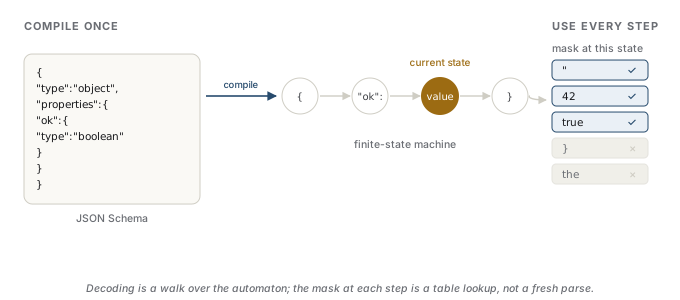
Regexes and JSON Schemas cover most of what applications need, but some targets — a whole programming language, deeply nested JSON — need the extra power of a context-free grammar, expressed in a notation like llama.cpp's GBNF. Grammars are heavier: a CFG's "legal next token" can depend on unbounded context (how many brackets are still open), so not every token can be pre-classified. Modern engines close much of that gap. XGrammar, for instance, splits the vocabulary into context-independent tokens it can check once ahead of time and the smaller set of context-dependent tokens it must resolve at runtime, which brings the per-step overhead of grammar-constrained JSON close to zero (Dong et al., 2024). This is why structured output moved from a research trick to a default feature of serving stacks: the machinery finally became cheap.
Interview
Why is regex-constrained decoding cheaper than grammar-constrained decoding? A regular expression compiles to a finite-state machine with a bounded number of states, so you can fully precompute the allowed-token set for each state and never touch the grammar again at run time. A context-free grammar can require a stack — unbounded nesting — so its set of legal tokens depends on run-time context that no finite index can enumerate in advance. The practical takeaway: reach for the weakest formalism that expresses your target. If a regex suffices, do not pay for a grammar.
20.4The format tax and other pitfalls
Constraining decoding guarantees a valid shape, not a good answer, and the two can pull apart. The mask only ever removes options; when it removes the token the model most wanted, you get an output that is perfectly well-formed and worse than what the model would have said unconstrained. Empirically this is not hypothetical: forcing models to answer under tight format restrictions measurably degrades their reasoning, and the tighter the constraint, the larger the hit (Tam et al., 2024). Call it the format tax on quality, distinct from the parsing tax of the first section.
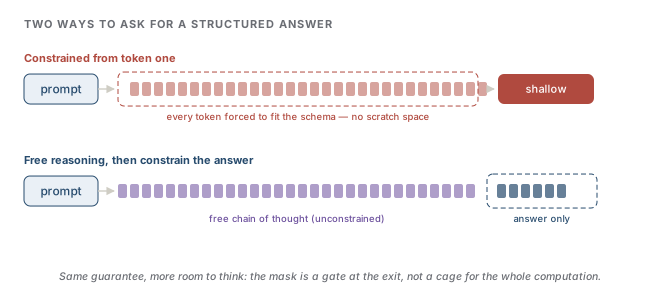
The mitigation follows from the diagnosis. Most of the tax comes from constraining the model while it is still working, so the standard move is to separate the two phases: let the model reason in free text — the chain of thought of Chapter 25 — and switch the constraint on only for the final answer. Reasoning models make this explicit, emitting an unconstrained thinking block and then a constrained answer block. The rule of thumb: never constrain the scratchpad; constrain only the part a program will actually read.
Common trap
Over-tight schemas cause their own damage. Pin a field to a strict enum and, if the true answer is not in your list, the model is forced to emit a wrong-but-valid value with full confidence — the constraint manufactures a hallucination the model would otherwise have hedged. Leave an escape hatch (an "other" option, a nullable field) for the cases your schema did not foresee, or you trade parse errors for silent semantic errors, which are worse.
The last cost is latency, and it comes in two forms. Compiling a complex schema or grammar into its automaton takes real time, so engines cache compiled constraints and reuse them across requests rather than rebuilding per call. The per-step mask is cheap by design (that was the point of the FSM index), but it is not free, and a poorly implemented constraint that re-parses the prefix every step can cost more than the retries it was meant to save.
Interview
When would you deliberately not use constrained decoding? When the task is reasoning-heavy and the output is read by a human, the format tax can outweigh the parsing convenience — you are better off letting the model answer freely and extracting structure in a cheap second pass. And on a closed API that exposes only "JSON mode" without a schema, you get validity of syntax but no guarantee of fields, so you still validate downstream. Constrained decoding is the right default for machine-consumed output, not a universal on-switch.
References
- Dong, Y., Ruan, C. F., Cai, Y., Lai, R., Xu, Z., Zhao, Y., & Chen, T. (2024). XGrammar: Flexible and efficient structured generation engine for large language models. arXiv preprint. arXiv:2411.15100.
- Tam, Z. R., Wu, C.-K., Tsai, Y.-L., Lin, C.-Y., Lee, H.-Y., & Chen, Y.-N. (2024). Let me speak freely? A study on the impact of format restrictions on performance of large language models. Proceedings of EMNLP 2024: Industry Track. arXiv:2408.02442.
- Willard, B. T., & Louf, R. (2023). Efficient guided generation for large language models. arXiv preprint. arXiv:2307.09702.
Check yourself
Interview-style questions on this chapter. Pick an answer to see whether it holds up.
-
A service appends 'reply only with JSON' to every prompt and gets valid JSON on 99% of calls. Why do teams still move to constrained decoding instead of accepting the 1%?
The problem is not the headline rate but where the failures land and what they cost: they concentrate on long or unusual inputs, each triggers a full extra forward pass, and parseable output can still carry wrong field names or types. Constrained decoding does not train the model at serving time, and it typically costs a little quality rather than restoring it (the format tax). -
Constrained decoding enforces a format by, at each step, setting the logits of all illegal tokens to negative infinity before sampling. What is the subtle reason this is hard to implement correctly?
The token-versus-character mismatch is the core wrinkle: a single token spans several format characters and rarely lands on a boundary, so legality is about which tokens' expansions keep the walk inside the grammar. Negative-infinity masking is numerically fine (those entries become exact zeros after softmax), the mask needs no extra forward pass, and temperature never reorders logits, so it cannot change which tokens are legal. -
Outlines-style guided generation compiles a regex or schema into a finite-state machine and precomputes, per state, the set of allowed vocabulary tokens. What does this buy over parsing the prefix afresh at each step?
The win is amortization: building the index from states to allowed tokens is done once, so each step is an O(1)-ish lookup instead of a reparse. A regex is strictly weaker than a CFG, not stronger, so it cannot express unbounded nesting. And the automaton still masks at run time and still imposes a format tax when it forbids the token the model wanted. -
You wrap a reasoning-heavy task in a strict JSON schema and force the model into the schema from its very first token. Accuracy drops compared to asking in free text. What is the most effective fix?
Most of the format tax comes from constraining the model while it is still working, so separating the phases — free chain of thought, then a constrained answer — keeps both the guarantee and the quality. Temperature does not restore the mass the mask removed; a CFG is not inherently looser than a schema; and stuffing reasoning into extra schema fields still forces that reasoning to conform to the format. -
A schema pins a field to a strict enum of five allowed values. On some inputs the true answer is none of the five. What does the constraint do, and why is it a trap?
An over-tight enum manufactures a hallucination: the mask removes the honest 'none of these' option, so the model must pick a wrong value and does so confidently. The decoder does not stall (some legal token always has the largest surviving logit) and it does not silently disable itself. The mitigation is to leave an escape hatch — an 'other' member or a nullable field — for cases the schema did not foresee.