3Tokenization
A language model never sees text. It sees a sequence of integers, produced by a tokenizer that chops text into pieces from a fixed vocabulary and numbers them. The tokenizer is a contract signed before training begins: the model's entire view of language — what it can compare, count, and complete — is mediated by these pieces. That makes tokenization the source of some of the strangest LLM behavior, and of very real serving costs, so it deserves a chapter before we build the transformer that consumes the tokens.
3.1Why not characters or words
The two obvious units both fail.
Words fail on the open-vocabulary problem. Any fixed word list will be missing tomorrow's product names, someone's typo, rare morphology ("untranslatable"), and most of every other language. Everything missing collapses into a single unknown-word token, and the model is blind to it.
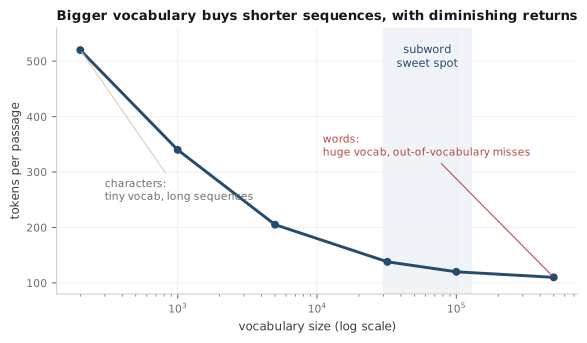
Characters never miss, but they are expensive. A character carries little meaning on its own, so the model burns layers reassembling words before it can think about them — and the sequences are long. Attention cost grows with the square of sequence length (Chapter 4), so 5× more positions is far more than 5× more compute. The context window, a scarce resource, fills with spelling.
Subword tokenization is the negotiated middle: a vocabulary of tens of thousands of pieces, where common words are a single token and rare words are built from a few fragments. The knob is vocabulary size, and it is a genuine tradeoff: a bigger vocabulary shortens sequences but grows the embedding matrix, and its rarest tokens are each seen less often during training, so their representations are worse.
Intuition
Tokenization is compression with a fixed dictionary: frequent strings earn a short code (one token), rare strings get spelled out from pieces. Frequency in the training corpus decides who earns a short code.
3.2Byte-pair encoding
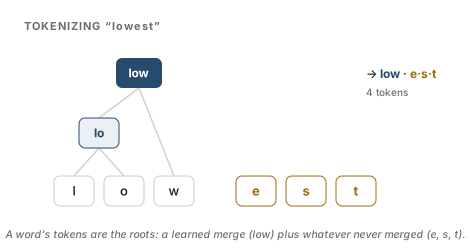
The dominant algorithm, byte-pair encoding (BPE), was born as a compression trick (Gage, 1994) and adapted for translation models (Sennrich et al., 2016). Building the vocabulary is greedy and simple: start from single characters, count adjacent pairs across the corpus, merge the most frequent pair into a new token, and repeat until you reach the target vocabulary size.
A toy corpus makes it concrete. Take low low low lower lowest and start from characters:
| Step | Most frequent pair | New token | The corpus now looks like |
|---|---|---|---|
| 0 | — | — | l o w · l o w · l o w · l o w e r · l o w e s t |
| 1 | l+o (5×) |
lo |
lo w · lo w · lo w · lo w e r · lo w e s t |
| 2 | lo+w (5×) |
low |
low · low · low · low e r · low e s t |
| 3 | low+e (2×) |
lowe |
low · low · low · lowe r · lowe s t |
The merges are the tokenizer. To tokenize new text at inference time, you replay the merge list in the order it was learned; lowest becomes lowe + s + t, even though the trainer never saw a vocabulary entry for it. Frequent whole words fused early; rare words decompose into learned fragments.
Analogy
A tokenizer is a stenographer's shorthand: the phrases the stenographer hears every day get a single stroke, and anything unusual is spelled out sign by sign. The analogy leaks at readback: a stenographer can still see the letters inside a stroke, but the model cannot — a token is an opaque integer, and whatever characters it "contains" are invisible unless the model memorized them during training.
3.3Byte-level BPE and friends
Production tokenizers are variations on this theme:
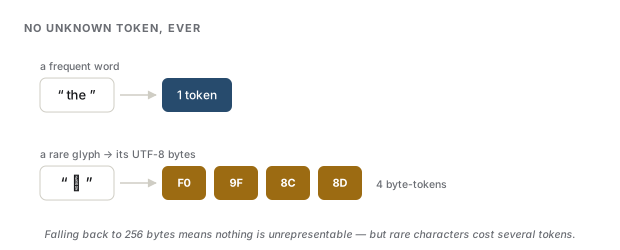
- Byte-level BPE runs BPE over the 256 possible bytes rather than characters, so every string — any language, any emoji, any binary garbage — is representable and there is no unknown token, ever. GPT-2 introduced this (Radford et al., 2019) and the GPT lineage kept it.
- WordPiece is BPE with a different merge criterion (Schuster & Nakajima, 2012): instead of the most frequent pair, it merges the pair that most raises the corpus likelihood under a unigram language model, which scores a pair roughly by its frequency divided by the product of its parts' frequencies. That normalization favors pairs that co-occur more than chance rather than pairs that are merely common because their parts are. It is the tokenizer of BERT (Devlin et al., 2019).
- Unigram flips the direction: start from a large candidate vocabulary and prune it down, keeping the pieces that best explain the corpus under a probabilistic model (Kudo, 2018).
- SentencePiece is the widely used library that packages these algorithms, treating text as a raw stream so the pipeline is language-agnostic and exactly reversible (Kudo & Richardson, 2018). The trick is to escape each space as a visible meta-symbol (
▁) that lives in the vocabulary, so detokenizing is just concatenation with▁mapped back to a space — no language-specific rules, and the reason a leading space usually binds to the following word as one token.
The differences matter less than the shared shape: a current open model ships a byte-level BPE or SentencePiece vocabulary of roughly 32k to 256k tokens, learned once from a corpus resembling its pretraining data, then frozen forever.
Interview
How would you make a model more robust to how its inputs get segmented? Randomize the segmentation during training. Subword regularization (Kudo, 2018) and BPE-dropout (Provilkov et al., 2020) stochastically drop some merges so a word is seen under several valid tokenizations, forcing the model to learn subword pieces that are not brittle to one exact split. Crucially it is a training-time trick: at inference the tokenizer runs deterministically, so there is no throughput cost. The distractor to avoid is thinking this changes the vocabulary — it changes only which segmentation the model sees during training.
Common trap
The tokenizer is part of the model. Feed a model token ids produced by a different tokenizer and you get confident garbage, not an error — the integers all "mean" something else. Swapping or extending a vocabulary after pretraining is possible but requires retraining the embeddings involved.
3.4Consequences of tokenization
A frozen, frequency-based view of text explains a family of famous quirks:
- Character blindness. Ask a model how many r's are in "strawberry" and it must answer from a token like
straw+berry— it does not see letters. Spelling, rhyming, and counting tasks fail not because the model is stupid but because the evidence was destroyed before it arrived. - Numbers. If
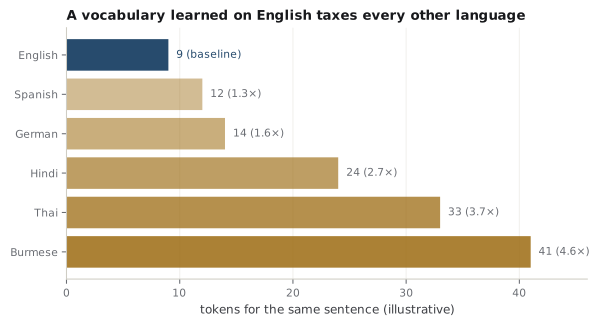
1234happens to be one token and1235is two, nearby numbers have wildly different shapes. Modern tokenizers force digits into fixed-size groups — some splitting single digits, some grouping from the right so that place value stays aligned across different numbers — which measurably helps arithmetic. It is a tokenizer design choice visibly changing a "reasoning" ability. - A non-English tax. Vocabularies learned from English-heavy corpora spend their short codes on English. The same sentence can cost several times more tokens in Thai or Telugu than in English (Petrov et al., 2023) — which means higher API cost, a smaller effective context window, and often worse quality, all before the model has done anything.
- Glitch tokens. A token that barely appeared in training data has an essentially untrained embedding, and feeding it to the model produces erratic behavior. Unusual byte sequences are also a place where filters and models can disagree about what text "says" — part of the injection surface Chapter 18 returns to.
Interview
Why do LLMs struggle to count letters in a word? Because tokenization hands the model opaque multi-character chunks; the letters inside a token are not part of the input. The model can only succeed where it has memorized spelling facts about its own tokens, which is why performance is inconsistent across words.
Interview
You double the tokenizer vocabulary. What changes? Sequences get shorter (cheaper attention, more effective context), but the embedding and output matrices grow, the softmax over the vocabulary costs more, and the added tokens are the rarest ones — each trained on fewer examples. Somewhere in the tens-to-hundreds of thousands the tradeoff stops paying; that is why vocabularies cluster there.
One economic point to carry forward: the token is the billing unit. API prices, context limits, and the serving throughput of Part IV are all denominated in tokens, so a tokenizer that spends 30% more tokens on your traffic is a 30% cost increase with no quality upside. When Chapter 15 measures tokens per second, remember that how much text a token buys was decided here.
With text turned into integers, we can now build the machine that reads them.
References
- Devlin, J., Chang, M.-W., Lee, K., & Toutanova, K. (2019). BERT: Pre-training of deep bidirectional transformers for language understanding. North American Chapter of the Association for Computational Linguistics. arXiv:1810.04805.
- Gage, P. (1994). A new algorithm for data compression. The C Users Journal, 12(2).
- Kudo, T. (2018). Subword regularization: Improving neural network translation models with multiple subword candidates. Association for Computational Linguistics. arXiv:1804.10959.
- Kudo, T., & Richardson, J. (2018). SentencePiece: A simple and language independent subword tokenizer and detokenizer for neural text processing. Empirical Methods in Natural Language Processing (System Demonstrations). arXiv:1808.06226.
- Petrov, A., La Malfa, E., Torr, P. H. S., & Bibi, A. (2023). Language model tokenizers introduce unfairness between languages. Advances in Neural Information Processing Systems. arXiv:2305.15425.
- Provilkov, I., Emelianenko, D., & Voita, E. (2020). BPE-dropout: Simple and effective subword regularization. Association for Computational Linguistics. arXiv:1910.13267.
- Radford, A., Wu, J., Child, R., Luan, D., Amodei, D., & Sutskever, I. (2019). Language models are unsupervised multitask learners. OpenAI technical report.
- Schuster, M., & Nakajima, K. (2012). Japanese and Korean voice search. IEEE International Conference on Acoustics, Speech and Signal Processing.
- Sennrich, R., Haddow, B., & Birch, A. (2016). Neural machine translation of rare words with subword units. Association for Computational Linguistics. arXiv:1508.07909.
Check yourself
Interview-style questions on this chapter. Pick an answer to see whether it holds up.
-
How does SentencePiece make detokenization exactly reversible without language-specific rules?
By escaping whitespace into a normal symbol in the vocabulary, SentencePiece removes the special-case handling of spaces; the sequence of pieces reconstructs the input by direct concatenation. This is why a leading space often binds to the following word as one token. -
WordPiece and BPE both merge subword pairs greedily. What distinguishes WordPiece's merge criterion?
BPE picks the most frequent adjacent pair; WordPiece picks the pair whose merge best improves a unigram language model's likelihood. That criterion normalizes by how common the parts already are, so a pair that co-occurs more than chance is preferred over one that is merely frequent because its parts are. -
You want a tokenizer-level trick that makes a translation model more robust to how words get split. What is BPE-dropout, and when does it apply?
BPE-dropout (Provilkov et al., 2020), a form of subword regularization (Kudo, 2018), stochastically omits merges while training so the model sees several valid tokenizations of the same string and learns more robust subword representations. Inference stays deterministic, so throughput is unaffected. -
Why do modern tokenizers often split numbers into fixed-size digit groups, sometimes grouped from the right?
If nearby numbers tokenize into wildly different shapes, the model has to learn each as an unrelated symbol. Forcing digits into consistent groups (and grouping from the least-significant digit) keeps ones, tens, and hundreds aligned across examples, which measurably helps arithmetic. It is a tokenizer choice changing a 'reasoning' ability. -
A model reliably miscounts the letters in 'strawberry', even though it spells many other words correctly. What is the real cause?
The evidence a letter-counting task needs is destroyed before the model sees it: 'strawberry' might arrive as two or three tokens with no exposed characters. Success is inconsistent across words precisely because it depends on memorized token-spelling facts, not on any counting ability.