24Evaluating Language Models
Every earlier part of this book improved a model; this part asks how you would know. That turns out to be the harder problem. Training a better model is now often gated not by compute or data but by the ability to measure whether a change helped — a noisy, contested, quickly-saturating signal. Evaluation is where progress is actually bottlenecked, and it is the part of the stack most likely to fool you: a number can rise while the thing you care about gets worse. This chapter is about earning trust in the numbers.
24.1Why evaluation is the hard part
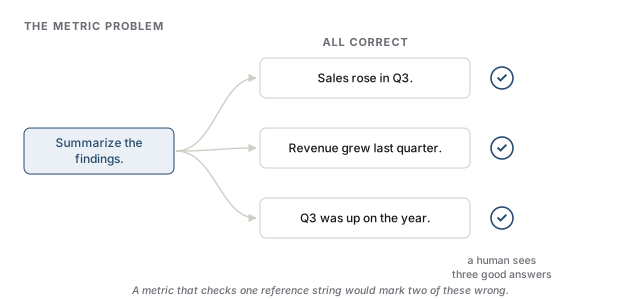
Classification has a ground truth: the label is cat or it is not, and accuracy is unambiguous. Open-ended generation does not. Ask a model to summarize a report, write a function, or explain a proof, and there are many good answers and many bad ones, with no single reference to check against. The moment output is a paragraph instead of a class, the clean metric disappears.
The old reflex is to compare against a reference string. Metrics like BLEU and ROUGE count n-gram overlap with a human-written answer, and they fail exactly where language is supposed to be flexible: a summary that is correct but differently worded scores low, and a fluent wrong answer that reuses the reference's words scores high. Overlap measures surface form, not meaning.
Intuition
A good evaluation has to reward being right, but for open-ended tasks "right" is a set of outputs, not a point. Every practical method in this chapter is a different way to approximate that set — with a benchmark, a model, or a human.
The escape hatch is to force the task back into a checkable shape: multiple-choice questions, unit tests that a code patch must pass, a math answer that either equals the key or does not. This is why so much of evaluation funnels into these formats. It buys objectivity at the cost of coverage: you can only measure what you can make checkable, and the most valuable model behaviors — judgment, tone, when not to answer — resist it.
24.2Benchmarks and their discontents
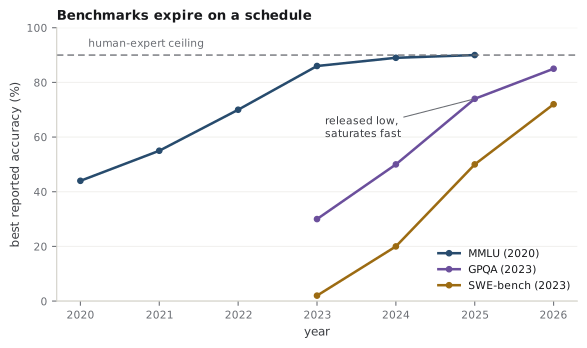
A benchmark packages a task into a fixed, scored dataset so different models get one comparable number. MMLU is the archetype: 57 subjects of multiple-choice questions from elementary to professional level, reduced to a single accuracy (Hendrycks et al., 2021). Benchmarks made the field legible — you can rank models — and that very legibility is their weakness, because a public number is a target.
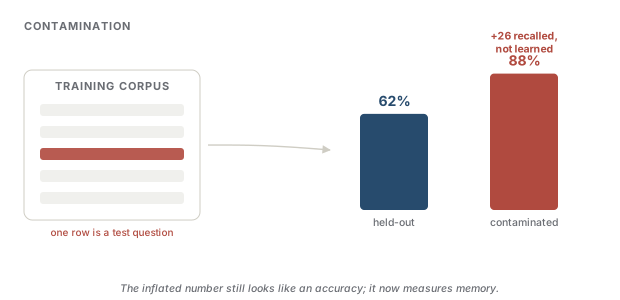
Three failure modes follow. Saturation: once frontier models pass human-expert accuracy, the benchmark stops discriminating; a suite that everyone scores 90 on ranks nothing. Contamination: the test questions are on the web, so they leak into pretraining corpora, and the model that "solves" them may be recalling them. Chapter 6 covered decontamination from the builder's side; from the evaluator's side the danger is that exact-match filtering never fully works, since a paraphrase of a leaked question survives it. Gaming: teams tune on the eval, directly or by picking data that happens to help it, and the score drifts away from the ability it once stood for.
Common trap
A rising benchmark score is consistent with the model getting better and with the test leaking into training. The two are indistinguishable from the number alone — which is why a suspiciously large jump on a public benchmark should raise your suspicion, not your confidence, until you can rule contamination out.
The response is an arms race toward benchmarks that are harder to saturate and harder to leak. GPQA writes "Google-proof" graduate questions that non-expert humans cannot solve even with web access, buying headroom (Rein et al., 2023). SWE-bench abandons multiple choice entirely: a model must produce a patch that makes a real repository's real test suite pass, which is expensive to fake and grounded in execution rather than a reference answer (Jimenez et al., 2024). Holistic suites push the other axis, measuring many models on many scenarios with accuracy, calibration, robustness, and bias side by side rather than one headline number (Liang et al., 2022).
The contamination worry is worth seeing concretely, because it changes what the number means, not just its size.
24.3When the grader is a model
For open-ended output with no reference, the dominant method is now LLM-as-judge: prompt a strong model to grade another model's answer, either scoring it alone (pointwise) or picking the better of two (pairwise) (Zheng et al., 2023). It scales to millions of examples at cents each, and on many tasks its verdicts agree with human raters about as often as two humans agree with each other — the bar that makes it usable at all.
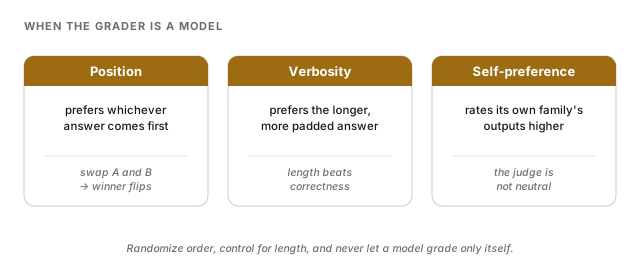
The catch is that the judge is a language model with a language model's biases, and they are systematic, not random. It exhibits position bias, favoring whichever answer it sees first; verbosity bias, preferring longer, more padded answers even when they are no more correct; and self-preference, scoring outputs from its own model family higher (Zheng et al., 2023). Systematic bias is the dangerous kind: averaging over more examples does not wash it out, it just estimates the wrong quantity more precisely.
Analogy
An LLM judge is a fast, cheap, tireless grader who has some fixed prejudices — always likes the longer essay, always leans toward the first paper in the stack. The analogy leaks because a human grader's prejudices are somewhat independent across people, so a panel cancels them; a fleet of copies of the same judge shares one bias, and quantity cannot cure it.
The defenses are mechanical. Randomize or swap the order of the two answers and average, so position cancels. Control for length, and be suspicious when the judge's preference tracks word count. Never let a model be the sole judge of its own outputs in a comparison it can win by self-preference. And calibrate against a human-labeled sample before trusting a judge on a new task, because agreement on chat quality does not imply agreement on, say, factual precision or safety.
Interview
Your new model wins 70% of pairwise judgments against the old one — ship it? Not yet. Check that the judge saw the two answers in randomized order, that the winner is not simply longer, and that the judge is not from the same family as one of the contestants. Then confirm the win holds on a human-labeled slice. A pairwise number is only as trustworthy as the controls around the judge that produced it.
24.4Human preference and the arena
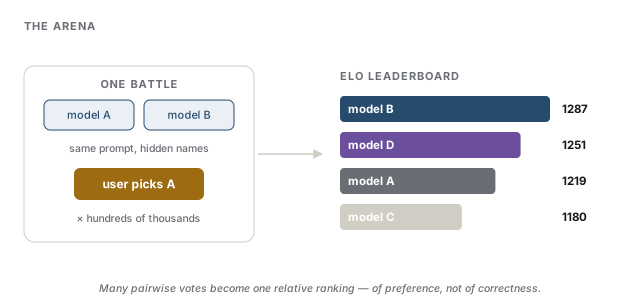
When you want the ground truth of "which answer do people actually prefer," you ask people. The scalable form is pairwise: show a rater two anonymous answers to the same prompt and record which they pick. Chatbot Arena turned this into a public platform where users chat with two hidden models, vote, and the votes accumulate (Chiang et al., 2024). Because each battle is relative, the votes are aggregated into an Elo-style rating — the same system that ranks chess players — producing one leaderboard from a flood of noisy pairwise comparisons (Zheng et al., 2023).
The arena is the closest thing the field has to a contamination-proof, hard-to-game evaluation: the prompts are fresh, live, and secret, and there is no fixed answer key to leak. But it measures a specific thing — aggregate human preference — and preference is not correctness. Raters reward answers that look confident, are nicely formatted, and agree with them; they cannot easily catch a subtle factual error or a citation that does not exist. It is also slow, and skewed toward the casual prompts people bring to a public demo, not the hard, domain-specific work your product may depend on. Popularity and quality correlate, but the gap between them is exactly where a fluent, well-formatted, wrong model wins.
Note
A leaderboard's rank is a summary statistic, and it can be worked. Labs can privately test many variants and reveal only the best, or optimize for the format raters like — pushing the score up without a matching gain in capability. Treat a single arena rank the way you would any one number that a lot of money is trying to move: as evidence, not verdict.
24.5Evals for your own product
Public benchmarks tell you about general capability; they say almost nothing about whether the model does your job. A support assistant, a contract summarizer, and a coding agent fail in different ways, and no leaderboard measures those ways. The single highest-leverage thing a team building on LLMs can do is write its own eval set: a few dozen to a few hundred real task instances with a checkable notion of success, drawn from actual usage.
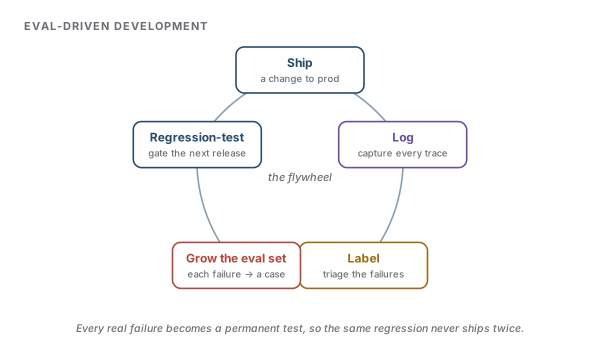
The mechanism that keeps it honest is a flywheel. Log every production interaction. Triage the failures and label them. Turn each distinct failure into a permanent case in the eval set. Run that set as a regression gate on every prompt change, model swap, or fine-tune, so a fix for one bug cannot silently reintroduce another. This is eval-driven development, and it inverts the usual order: you write the failing eval first, then change the system until it passes, exactly as you would with tests.
Interview
How do you evaluate a RAG or agent system, where the model is one part of a pipeline? End-to-end task success is the number that matters, but it hides where failure happened, so you also instrument the stages: did retrieval surface the right document (Chapter 21), did the agent call the right tool with the right arguments (Chapter 22), did generation stay faithful to what it retrieved? A single end-to-end score tells you the system is broken; per-stage evals tell you which part to fix.
There is a deeper reason evals matter more the closer you get to production: optimization pressure finds whatever you measure. This is Goodhart's law, the same force behind reward over-optimization in Chapter 11 — a metric under pressure stops being a good metric. The defense is not one perfect number but a diverse, evolving suite that is expensive to game precisely because it keeps changing as your product meets reality.
Trustworthy evaluation is what lets every other chapter's improvement be believed. It is also the field's rate limiter: measuring the newest capabilities — long-horizon reasoning (Chapter 25), autonomy, honesty under pressure — is genuinely unsolved, which is why Chapter 26 returns to evaluation we can trust as one of the open problems that will shape what comes next.
References
- Chiang, W.-L., Zheng, L., Sheng, Y., Angelopoulos, A. N., et al. (2024). Chatbot Arena: an open platform for evaluating LLMs by human preference. International Conference on Machine Learning. arXiv:2403.04132.
- Hendrycks, D., Burns, C., Basart, S., Zou, A., et al. (2021). Measuring massive multitask language understanding. International Conference on Learning Representations. arXiv:2009.03300.
- Jimenez, C. E., Yang, J., Wettig, A., Yao, S., et al. (2024). SWE-bench: can language models resolve real-world GitHub issues?. International Conference on Learning Representations. arXiv:2310.06770.
- Liang, P., Bommasani, R., Lee, T., Tsipras, D., et al. (2022). Holistic evaluation of language models. Transactions on Machine Learning Research. arXiv:2211.09110.
- Rein, D., Hou, B. L., Stickland, A. C., Petty, J., et al. (2023). GPQA: a graduate-level Google-proof Q&A benchmark. arXiv preprint. arXiv:2311.12022.
- Zheng, L., Chiang, W.-L., Sheng, Y., Zhuang, S., et al. (2023). Judging LLM-as-a-judge with MT-Bench and Chatbot Arena. Advances in Neural Information Processing Systems. arXiv:2306.05685.
Check yourself
Interview-style questions on this chapter. Pick an answer to see whether it holds up.
-
A model's accuracy on a public benchmark jumps sharply after a new pretraining run. Why is this evidence weaker than it looks?
Contamination and real improvement are indistinguishable from the score itself, which is why a large jump should raise suspicion until you rule leakage out. The subtler point is that contamination does not merely inflate the number; it silently converts a test of generalization into a test of recall, so the metric measures a different thing while still looking like accuracy. Exact-match decontamination does not save you, because paraphrases of leaked questions survive it. -
You grade a new model with a strong LLM judge and average over 10,000 pairwise comparisons to shrink the error bars. Why does this not make position and verbosity bias go away?
Systematic bias shifts every comparison in the same direction, so averaging sharpens an estimate of the wrong quantity rather than correcting it. This is why the fixes are procedural: randomize or swap answer order and average across the swap, control for length, and keep a model from judging its own family. It is the opposite of random noise, which genuinely does shrink with more samples. -
Chatbot Arena aggregates anonymous pairwise votes into an Elo leaderboard. What does a high Arena rating actually certify?
The arena measures aggregate human preference, which correlates with quality but is not the same thing: raters reward confidence, formatting, and agreement, and struggle to catch subtle factual errors. Fresh secret prompts do make it hard to game by contamination, but that guards the signal's integrity, not its meaning. And arena traffic skews toward casual prompts, so it under-samples exactly the specialized work a product may depend on. -
Why do n-gram-overlap metrics like BLEU and ROUGE fail as measures of open-ended generation quality?
Overlap metrics reward matching surface form, not meaning, which is backwards for tasks where the whole point is flexible phrasing. That is why evaluation either forces output back into a checkable shape (multiple choice, unit tests, an answer key) or hands grading to a model or a human who can judge meaning. BLEU and ROUGE are string statistics, not embedding models, and they do use a reference. -
A team optimizes hard against its favorite eval score for months; the score keeps climbing but users complain the product got worse. What principle explains this?
When a measure becomes a target, optimization finds whatever the metric rewards rather than the ability it stood for. It is the same force as reward over-optimization in RLHF, not a separate phenomenon, and a fresh held-out split only delays it. The practical defense is a diverse, evolving suite that is expensive to game precisely because it keeps changing as the product meets reality.