10Supervised Fine-Tuning
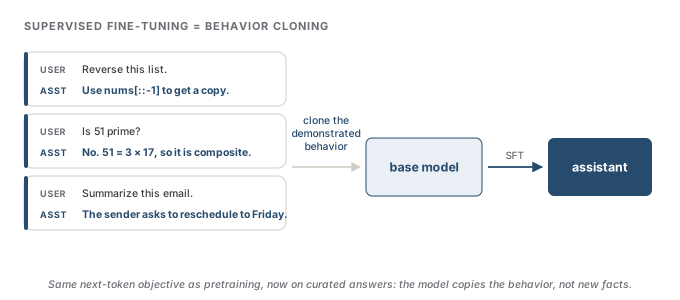
A base model has read much of the internet, but no one has ever shown it how to behave. Ask it a question and it may answer, or it may reply with three more questions, or drift into a listicle — because in its training data a bare question was as often the start of a forum thread as the setup for an answer (Chapter 1). Supervised fine-tuning (SFT) is the first and simplest fix: gather thousands of worked demonstrations of an assistant responding well, and train the model to imitate them with the very same next-token objective it was pretrained on. This is behavior cloning. The move that makes it work is subtle: SFT does not so much pour new facts into the model as select, from everything pretraining already stored, the narrow slice of behavior that a helpful assistant exhibits.
10.1From a document completer to an assistant
The base model is a document completer, and that is the whole problem. It very likely knows that the capital of France is Paris — it will produce "Paris" readily in the middle of an encyclopedia article — but it has not learned that a prompt is a request to be answered rather than a document to be continued. The gap is not knowledge; it is persona and format. The model needs to be told, by example, what kind of text should follow a user's turn.
SFT supplies those examples. You assemble a dataset of demonstrations — each an instruction paired with an ideal response — and run the ordinary training loop over them, minimizing cross-entropy on the response tokens (Ouyang et al., 2022). Because the objective is unchanged, SFT is cheap next to pretraining: a few epochs over tens of thousands to a few hundred thousand demonstrations, against the trillions of tokens of Chapter 6. Fine-tuning on instructions phrased across many tasks was the finding that first made this generalize — a model tuned to follow instructions on one set of tasks follows unseen instructions zero-shot (Wei et al., 2021).
Intuition
Pretraining teaches the model everything it will ever know; SFT only teaches it which of those things to say, and how, when someone asks.
Analogy
SFT is an apprentice shadowing an expert, copying what a good answer looks like. The analogy leaks in the way that matters most: the apprentice only ever imitates behaviors it was shown and silently inherits the demonstrator's mistakes; it never learns from the consequences of its own attempts. Closing that gap — letting the model improve past its demonstrations — is what RLHF (Chapter 11) is for.
Interview
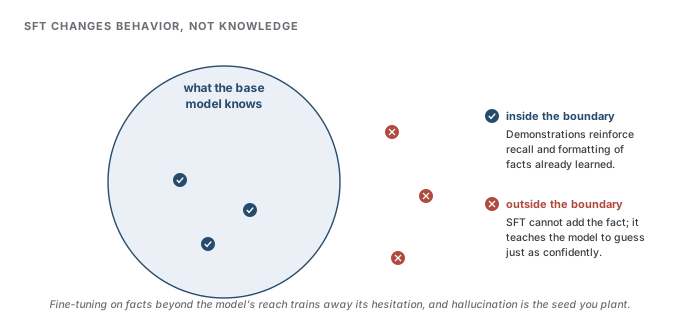
Does SFT teach the model new knowledge? Almost none. A demonstration is seen a handful of times at a small learning rate, which is nowhere near enough to install a fact the base model lacks; what SFT reliably changes is behavior — format, tone, willingness to answer, task framing. This is why teams put their factual effort into the pretraining mixture (Chapter 6) and treat SFT as behavior shaping. It is also the setup for the chapter's sharpest failure mode: demand facts the base model does not have and SFT teaches confident guessing instead.
10.2Instruction data and chat templates
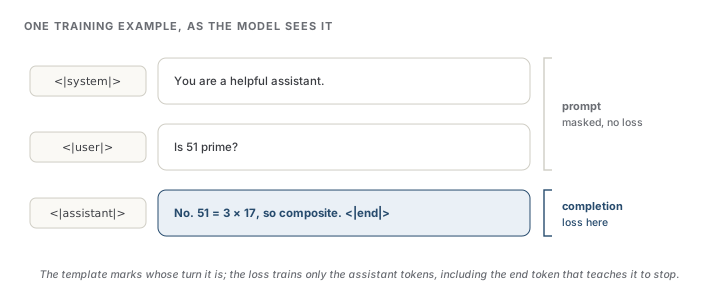
SFT data is conversations, not raw text. Each example carries roles — a system message that sets policy, a user turn, an assistant turn, sometimes many turns — and the model must learn to tell whose turn it is and to generate only the assistant's part. To make roles legible, every turn is wrapped in a chat template: a fixed format that delimits each role with special tokens like <|user|> and <|assistant|>, added to the vocabulary as their own atoms (Chapter 3). Different model families use different templates, and this is a live deployment trap — feed a model a template it was not trained on and it quietly degrades, because the role tokens it keys on are missing (more in Chapter 18).
The second essential trick is loss masking: compute the loss only on the assistant's tokens and mask out the system and user tokens. You want the model to learn to produce responses, not to model the user's phrasing; training on the prompt spends capacity teaching it to generate instructions, which is not the job. The end-of-turn token is masked in, deliberately — training on it is how the model learns to stop, rather than answering and then rambling into an invented next turn.
Interview
Why mask the prompt tokens instead of training on the whole sequence? The task is to map a prompt to a good completion, so the gradient should come only from the completion; training on the prompt teaches the model to predict user messages, which wastes capacity and can bias it toward parroting the input. On short demonstrations, unmasked training also lets the easy-to-predict boilerplate of the prompt dominate the loss. A related efficiency detail: multiple short conversations are often packed into one sequence, with the attention masked at the boundaries so examples cannot read across each other.
10.3How much data, and of what quality
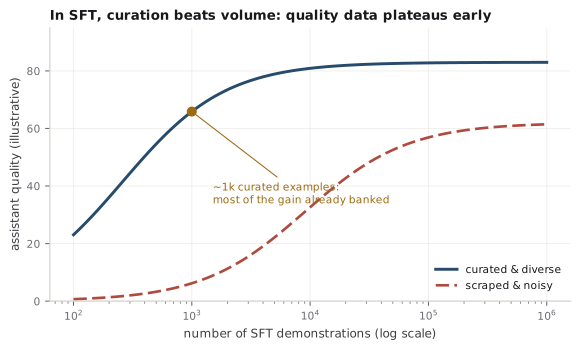
Here the surprising result is how little data SFT needs. LIMA fine-tuned a strong base model on just 1,000 carefully curated prompt-response pairs, with no reinforcement learning, and produced an assistant competitive with far more heavily tuned systems (Zhou et al., 2023). The authors read this as evidence for a superficial alignment hypothesis: a model's knowledge and capabilities are learned almost entirely in pretraining, and alignment mostly teaches the format and style in which to expose them — so a small, diverse, high-quality set is enough to select the right behavior.
The practical corollary is that quality and diversity beat sheer volume, and the failure it warns against is real: because SFT mostly shapes presentation, it is easy to make outputs look better — fluent, formatted, confident — without making them more correct. Optimizing your demonstrations for polish over substance produces exactly that. Early SFT sets were hand-written, which is expensive; modern pipelines lean on synthetic data, either bootstrapping instructions from the model itself (Wang et al., 2023) or distilling demonstrations from a stronger model, then filtering hard for quality and task coverage (Grattafiori et al., 2024). Coverage — how many genuinely different kinds of request appear — tends to matter more than raw count.
Common trap
A higher SFT loss on a held-out set is not the goal, and neither is a lower one — SFT quality is about which behaviors you cloned, not how tightly you fit them. Overfitting a large, uniform set makes the model more fluent and more templated at once, which reads as improvement right up until you probe substance.
Interview
You have 50,000 scraped demonstrations and 1,000 hand-checked ones. Which do you train on? The clean thousand, or the scraped set aggressively filtered down toward that quality bar. Noisy demonstrations teach noisy behavior — sloppy formats, wrong answers stated confidently, inconsistent refusals — and SFT clones all of it faithfully. The LIMA result is the license to throw data away; the win is in curation and diversity, not headcount.
10.4Failure modes
SFT is powerful precisely because it clones behavior faithfully, which is also how it goes wrong. Catastrophic forgetting comes first: train too long or too hot on a narrow set and the model erodes the broad competence pretraining gave it, trading generality for the demonstration style. The defenses are all forms of restraint — few epochs, a small learning rate, mixing in general data, or freezing most weights and tuning a thin adapter (PEFT and LoRA, Chapter 13). Format overfitting is the milder cousin: the model latches onto surface habits of the demonstrations, opening every answer with the same preamble or forcing everything into bullet lists.
Two failure modes are subtler and more consequential. Sycophancy can be seeded here: if demonstrations consistently agree with or flatter the user, the model learns agreement as the expected behavior. The effect is amplified later by preference optimization, where human raters reward answers that match their beliefs (Sharma et al., 2023), but demonstrations that never push back plant the seed (Chapter 12). And hallucination has a specific, well-documented root in SFT. When demonstrations require facts the base model does not hold, fine-tuning does not install them — such examples are learned slowly, and as the model finally fits them, its overall tendency to hallucinate rises measurably (Gekhman et al., 2024). You have not taught it the fact; you have taught it to answer just as confidently when it is guessing.
Intuition
Keep your demonstrations inside the base model's knowledge, and where you cannot, demonstrate the honest answer — "I don't know" — so that not-knowing is one of the behaviors you clone (Chapter 26).
SFT gets you a competent imitator, and no further: the model is capped by the quality of its demonstrations and cannot learn from the consequences of its own answers. To push past the best demonstration — and to teach the model what people actually prefer among the answers it could give — you stop cloning behavior and start optimizing against a preference signal, which is where RLHF (Chapter 11) and preference optimization (Chapter 12) take over.
References
- Gekhman, Z., Yona, G., Aharoni, R., Eyal, M., et al. (2024). Does fine-tuning LLMs on new knowledge encourage hallucinations?. Conference on Empirical Methods in Natural Language Processing. arXiv:2405.05904.
- Grattafiori, A., Dubey, A., Jauhri, A., Pandey, A., et al. (2024). The Llama 3 herd of models. arXiv preprint. arXiv:2407.21783.
- Ouyang, L., Wu, J., Jiang, X., Almeida, D., et al. (2022). Training language models to follow instructions with human feedback. Advances in Neural Information Processing Systems. arXiv:2203.02155.
- Sharma, M., Tong, M., Korbak, T., Duvenaud, D., et al. (2023). Towards understanding sycophancy in language models. arXiv preprint. arXiv:2310.13548.
- Wang, Y., Kordi, Y., Mishra, S., Liu, A., et al. (2023). Self-Instruct: Aligning language models with self-generated instructions. Annual Meeting of the Association for Computational Linguistics. arXiv:2212.10560.
- Wei, J., Bosma, M., Zhao, V. Y., Guu, K., et al. (2021). Finetuned language models are zero-shot learners. arXiv preprint. arXiv:2109.01652.
- Zhou, C., Liu, P., Xu, P., Iyer, S., et al. (2023). LIMA: Less is more for alignment. Advances in Neural Information Processing Systems. arXiv:2305.11206.
Check yourself
Interview-style questions on this chapter. Pick an answer to see whether it holds up.
-
A team fine-tunes a base model on 100,000 high-quality demonstrations that include many facts the base model never saw in pretraining. After SFT the model states those facts fluently but is wrong about them, and about nearby questions, more often than before. What best explains this?
Gekhman et al. (2024) found that examples introducing new knowledge are learned slowly, and as the model finally fits them its overall hallucination rate rises. SFT shapes behavior, not knowledge, so it teaches the model to answer as confidently when guessing as when it knows. This is distinct from catastrophic forgetting, which is the erosion of general capability from over-tuning, not a fact-specific effect — and adding more of the same out-of-knowledge data makes it worse, not better. -
Standard SFT computes the loss only on the assistant's tokens, masking the system and user tokens. What is the main consequence of instead training on every token in each conversation?
The task is to map a prompt to a good completion, so the gradient should come only from the completion. Training on the prompt teaches the model to predict user messages, which wastes capacity. The leakage option confuses loss masking with the causal mask, which already prevents reading ahead; and the end-of-turn token is part of the completion, so it stays unmasked precisely so the model learns to stop. -
LIMA aligned a strong base model into a competitive assistant using only about 1,000 curated demonstrations and no reinforcement learning. Which conclusion does this most directly support?
This is the superficial alignment hypothesis (Zhou et al., 2023): knowledge and skills come from pretraining, and alignment largely teaches the style in which to expose them. The base model still needs SFT — it is not aligned by default — and preference optimization (Chapters 11-12) still adds value beyond demonstrations, so the lesson is about quality and diversity, not a magic example count. -
A well-tuned instruct model gives rambling, lower-quality answers in production, even though the identical weights scored well in your offline eval harness. What is the most likely single cause?
A template mismatch between training and serving is a classic deployment bug (Chapter 18): the model keys on role tokens like the assistant marker, and without them it falls back toward base-model continuation. Quantization rarely erases instruction-following, greedy decoding is a normal default, and a correct KV cache reproduces full-context attention exactly. -
You scale SFT by distilling 500,000 demonstrations from a stronger model. Held-out human ratings of your responses jump, but accuracy on a factual knowledge benchmark barely moves and dips slightly. What is the best explanation?
Because SFT surfaces behavior the base model already has, polishing presentation raises perceived quality without teaching facts — the 'style over substance' trap. Distillation can propagate a teacher's errors, but framing that as the 'sole' cause and 'always' true overstates it; and ratings and benchmark accuracy routinely diverge precisely because they measure different things.