17Serving Systems in Production
A trained, quantized model is a file on disk. A serving system is the software that turns that file into a service — one that answers thousands of users at once, keeps its promises about speed, and does not cost more to run than it earns. This is the layer between the weights and the API, and it is where the ideas of the last three chapters — how you decode (Chapter 14), the prefill/decode split and the KV cache (Chapter 15), and fewer bits per weight (Chapter 16) — stop being properties of one request and start being properties of a fleet. The whole chapter turns on one tension: the tricks that make a single request fast can make the system slow, and resolving that tradeoff is the serving engineer's real job.
17.1What a serving stack must do
Start with what a user actually feels, because it splits into two separate clocks. Time to first token (TTFT) is the wait from sending a prompt to seeing the first word appear; it is set by prefill, the one-shot pass that reads the whole prompt, so it grows with prompt length. Time per output token (TPOT, also called inter-token latency) is the pace of every word after that; it is set by decode, the memory-bandwidth-bound step that streams the KV cache once per token (Chapter 15). A chat feels sluggish if either clock is slow, but for different reasons and with different fixes.
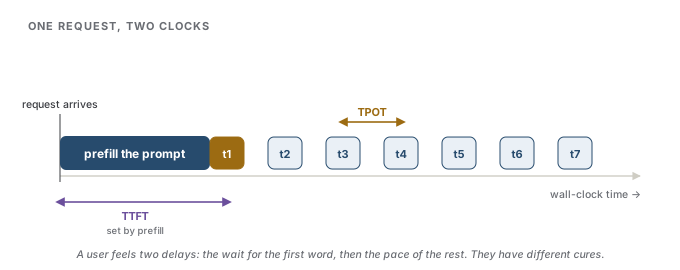
Against these sit throughput — total tokens per second across all concurrent users — and cost, which for a fixed GPU is just the inverse of throughput. The tension is that latency and throughput pull opposite ways: the batching that lifts throughput makes each user wait a little longer in the queue and share the GPU. So you do not "make it fast"; you commit to service-level objectives (SLOs) — say, TTFT under 500 ms and TPOT under 50 ms at the 99th percentile — and then maximize throughput subject to meeting them.
Intuition
A serving system is a restaurant kitchen, not a personal chef. One diner served alone gets their meal fastest, but the kitchen earns nothing; the art is cooking many orders at once so no single table waits past what it will tolerate.
Interview
Your TTFT is fine but users complain the model "types slowly." Which knob? That is a TPOT problem, so look at decode, not prefill. Decode is bound by streaming the KV cache from memory each step, so the levers are a smaller cache (GQA, quantized KV; Chapters 5 and 16), a smaller batch on that replica, or speculative decoding (Chapter 15). Throwing more prompt-side compute at it does nothing, because prefill already finished.
17.2The engines
You almost never write this layer yourself; you pick an inference engine. Four dominate in 2026, and each is known for one signature idea. vLLM popularized PagedAttention, which stores the KV cache in fixed-size pages so memory is not fragmented by variable-length sequences, and pairs it with continuous batching (Kwon et al., 2023); it is the open-source default. TensorRT-LLM compiles a model into fused, hardware-specific kernels ahead of time, trading flexibility for peak throughput on NVIDIA hardware. SGLang is built around RadixAttention, a prefix cache that reuses shared prompt prefixes automatically, and fast structured-output decoding, which makes it strong for agents and heavily templated workloads (Zheng et al., 2024). Text Generation Inference (TGI) is Hugging Face's production wrapper, valued less for a novel kernel than for streaming, metrics, and safe rollout inside that ecosystem.
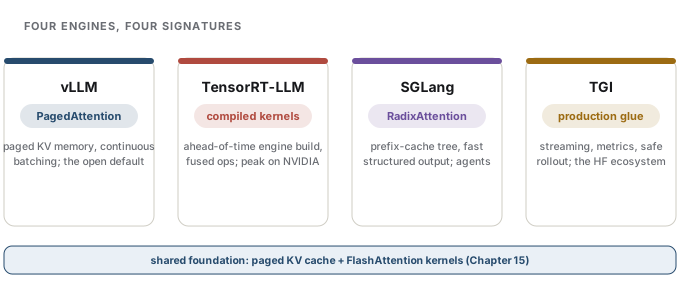
The important point is that these engines share more than they differ: nearly all now do paged KV memory, continuous batching, prefix caching, and FlashAttention-style kernels (Dao et al., 2022). So the choice is rarely about raw speed on a single benchmark and usually about fit — TensorRT-LLM if you will pay a compile step for the last 20% on NVIDIA, SGLang if your traffic has long shared prefixes, TGI or vLLM if you want to swap models freely.
Interview
Why not just call a model's generate() in a loop behind a web server? Because it serves one request at a time and re-runs prefill from scratch on every call, so your GPU sits mostly idle and your cost per token is an order of magnitude too high. Everything an engine adds — continuous batching, a paged and reusable KV cache, scheduling — exists to keep that expensive GPU busy across many requests at once.
17.3Multi-request scheduling
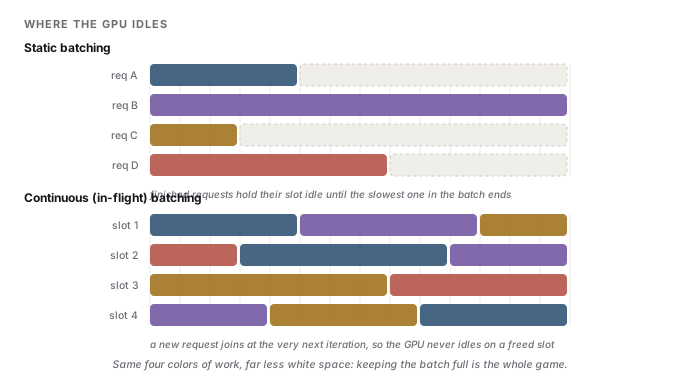
The engine's real intelligence is in scheduling many requests onto one GPU. The foundational move is continuous batching (also called in-flight or iteration-level batching), introduced by Orca: instead of freezing a batch until every request in it finishes, the scheduler makes decisions every iteration, so a request that completes early releases its slot immediately and a newly arrived one joins on the next step (Yu et al., 2022). Static batching wastes the GPU whenever requests in a batch have different lengths, which they always do.
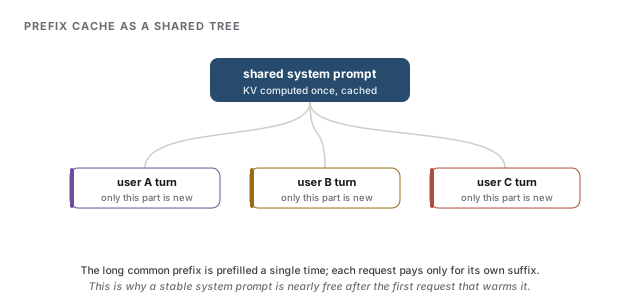
The second lever is prefix caching: when many requests share a long common prefix — a system prompt, a few-shot preamble, a document everyone asks about — you prefill that prefix once and reuse its KV cache for all of them. SGLang's RadixAttention organizes cached prefixes in a tree so overlaps are found and shared automatically (Zheng et al., 2024). A stable system prompt is therefore nearly free after the first request warms it, which is why prompt design and serving cost are linked.
Two refinements handle the messiness of mixed traffic. A long prefill can stall everyone else's decode, since one big compute step blocks the batch; chunked prefill slices a prompt into pieces and interleaves them with ongoing decodes, smoothing tail latency (Agrawal et al., 2024). Going further, prefill/decode disaggregation runs the two phases on different GPU pools — prefill is compute-bound, decode is memory-bound, so co-locating them makes each interfere with the other — and routing them separately lets you scale and tune each for its own bottleneck (Zhong et al., 2024). On top of all this sits ordinary prioritization and fairness: without it, one user streaming a 100K-token prompt starves everyone behind them.
Analogy
Continuous batching is a ride-share van that picks up and drops off along the route instead of waiting to fill and empty all at once. The analogy leaks in that van seats are interchangeable, but a request also carries its growing KV cache, so "seating" a new rider costs memory that a real van never charges — which is exactly the pressure PagedAttention was built to relieve.
17.4Autoscaling and the economics
Zoom out to the fleet and one number governs everything: GPU utilization. A GPU costs the same whether it serves one token per second or three thousand, so the unit cost of a token is essentially rental price divided by throughput, and throughput is set almost entirely by how full your batches are. This is why batching is not one optimization among many — it is the cost story.
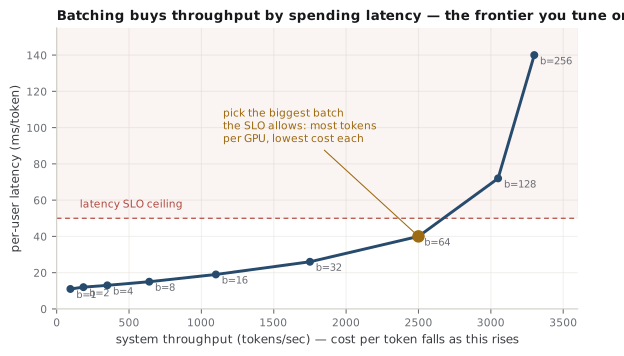
Autoscaling adjusts replica count to demand, usually off queue depth or TTFT rather than raw GPU percentage, because a GPU can look busy while delivering terrible latency. The hard part is the cold start: spinning up a new replica means loading tens of gigabytes of weights into VRAM and warming caches, which takes tens of seconds to minutes — an eternity when a traffic spike is happening now. Teams fight this by keeping warm pools, quantizing to shrink load time (Chapter 16), and scaling ahead of demand instead of reacting to it.
Interview
Where does the cost of a served token actually go, and what is the biggest lever? Cost per token is GPU-hour price divided by tokens produced per hour, so the dominant lever is throughput at fixed hardware, and the dominant lever on throughput is effective batch size — keeping the GPU full. Quantization and a smaller KV cache help mainly because they let you fit a bigger batch in the same memory, not because the arithmetic itself got cheaper. A team obsessing over kernel microseconds while running batch sizes of two is optimizing the wrong end.
Serving is where the whole book meets the electricity bill. A model is only as good as the service wrapped around it can deliver, affordably, at the ninety-ninth percentile — and Part V now turns to the other half of that wrapper: the prompts, tools, and guardrails that decide what the model is actually asked to do.
References
- Agrawal, A., Kedia, N., Panwar, A., Mohan, J., et al. (2024). Taming throughput-latency tradeoff in LLM inference with Sarathi-Serve. USENIX Symposium on Operating Systems Design and Implementation (OSDI 24). arXiv:2403.02310.
- Dao, T., Fu, D. Y., Ermon, S., Rudra, A., & Ré, C. (2022). FlashAttention: Fast and memory-efficient exact attention with IO-awareness. Advances in Neural Information Processing Systems. arXiv:2205.14135.
- Kwon, W., Li, Z., Zhuang, S., Sheng, Y., et al. (2023). Efficient memory management for large language model serving with PagedAttention. ACM Symposium on Operating Systems Principles (SOSP). arXiv:2309.06180.
- Yu, G.-I., Jeong, J. S., Kim, G.-W., Kim, S., & Chun, B.-G. (2022). Orca: A distributed serving system for transformer-based generative models. USENIX Symposium on Operating Systems Design and Implementation (OSDI 22).
- Zheng, L., Yin, L., Xie, Z., Sun, C., et al. (2024). SGLang: Efficient execution of structured language model programs. Advances in Neural Information Processing Systems. arXiv:2312.07104.
- Zhong, Y., Liu, S., Chen, J., Hu, J., et al. (2024). DistServe: Disaggregating prefill and decoding for goodput-optimized large language model serving. USENIX Symposium on Operating Systems Design and Implementation (OSDI 24). arXiv:2401.09670.
Check yourself
Interview-style questions on this chapter. Pick an answer to see whether it holds up.
-
Raising a replica's batch size lowers the cost of each generated token but makes individual users wait longer per token. What is the correct explanation of both effects at once?
Throughput, not per-request arithmetic, sets unit cost: the GPU rents for the same price whether it emits ten tokens a second or three thousand. Decode is memory-bandwidth-bound, so batching adds users almost for free until the GPU turns compute-bound at the knee of the curve, past which extra latency buys little throughput. This is why 'keep the batch full' is the whole cost story. -
Continuous (iteration-level) batching is the core scheduling idea in modern engines. Concretely, what does it change relative to static batching?
Orca's insight was to schedule at the granularity of a single decode iteration rather than a whole request. Because requests in a batch have different lengths, a static batch leaves finished slots idle until the longest one drains; iteration-level scheduling refills them at once. The KV-cache-sharing option describes grouped-query attention, an unrelated lever. -
A workload sends the same 2,000-token system prompt with every request. With prefix caching enabled, why does that shared prompt become nearly free after the first request?
Prefix caching (SGLang's RadixAttention organizes it as a tree) keys on the shared token prefix and reuses its stored KV entries across requests that arrive at different times, not just within one batch. The per-batch option is the tempting near-miss: it captures reuse but misses that the cache persists across time, which is where most of the saving comes from. -
Some serving stacks split prefill and decode onto separate GPU pools (disaggregation), or interleave chunked prefills with decodes on one pool. What problem are both attacking?
The two phases have opposite bottlenecks, so co-locating them makes each degrade the other: one big prefill step blocks every decode in the batch, wrecking TPOT. Chunked prefill (Sarathi-Serve) slices the prefill and interleaves it; disaggregation (DistServe) routes the phases to pools tuned for compute versus bandwidth. Both target interference, not precision or raw memory. -
You are choosing a serving engine. Which situation most specifically favors SGLang over the alternatives?
SGLang's signature is RadixAttention, which reuses overlapping prompt prefixes automatically, so it shines when prefixes are long and widely shared. The peak-throughput-via-compilation case points to TensorRT-LLM, the ecosystem case to TGI, and paged memory is now table stakes everywhere (it originated in vLLM's PagedAttention), so it no longer distinguishes one engine.